Open a commercial electricity bill and you will usually see two kinds of network charge. One is for how much energy you used, measured in kilowatt hours (kWh). The other is for how hard your site pulled power from the grid at its busiest time, measured in kilowatts (kW) or kilovolt amperes (kVA). That second one is the demand charge.
Most demand charges are based on the highest demand recorded over a set interval, commonly 30 minutes, during the billing month. Some tariffs carry that highest reading forward for 12 months. Which rule applies to you depends on your network and your tariff.
Most businesses on a demand tariff have never checked when their peak happens or what causes it. This article explains how demand charges work, how to find yours on the bill, what drives them on site, and how an energy audit finds the peaks worth fixing.
What Is a Demand Charge?
Electricity networks have to build poles, wires and transformers big enough to carry the highest load their customers draw. The demand charge is how the network recovers that cost from larger users.
Energy charges reward you for using less in total. Demand charges reward you for using power more evenly. A site that runs 200 kW steadily all day can pay less in demand charges than a site that uses less energy overall but spikes to 300 kW for half an hour each morning.
Your meter does not bill the single highest instant. Energex, for example, states that billable demand is "typically recorded in your electricity meter as the average demand, over a 30-minute period". So a motor start that lasts ten seconds matters far less than several large loads running together for half an hour.
In South East Queensland, Energex classes businesses using more than 100 MWh a year as large customers, and its large business network tariffs include a demand charge. Other networks set their own thresholds and tariffs, so these examples may not match your site.
How to Find Your Demand Charge on an Australian Electricity Bill
Look on your bill for lines labelled "demand", "capacity", "kVA" or "kW", and note the network tariff code. If your bill only shows a retailer total, ask your retailer for the network tariff code and the demand line items. The tariff code tells you which of these structures applies.
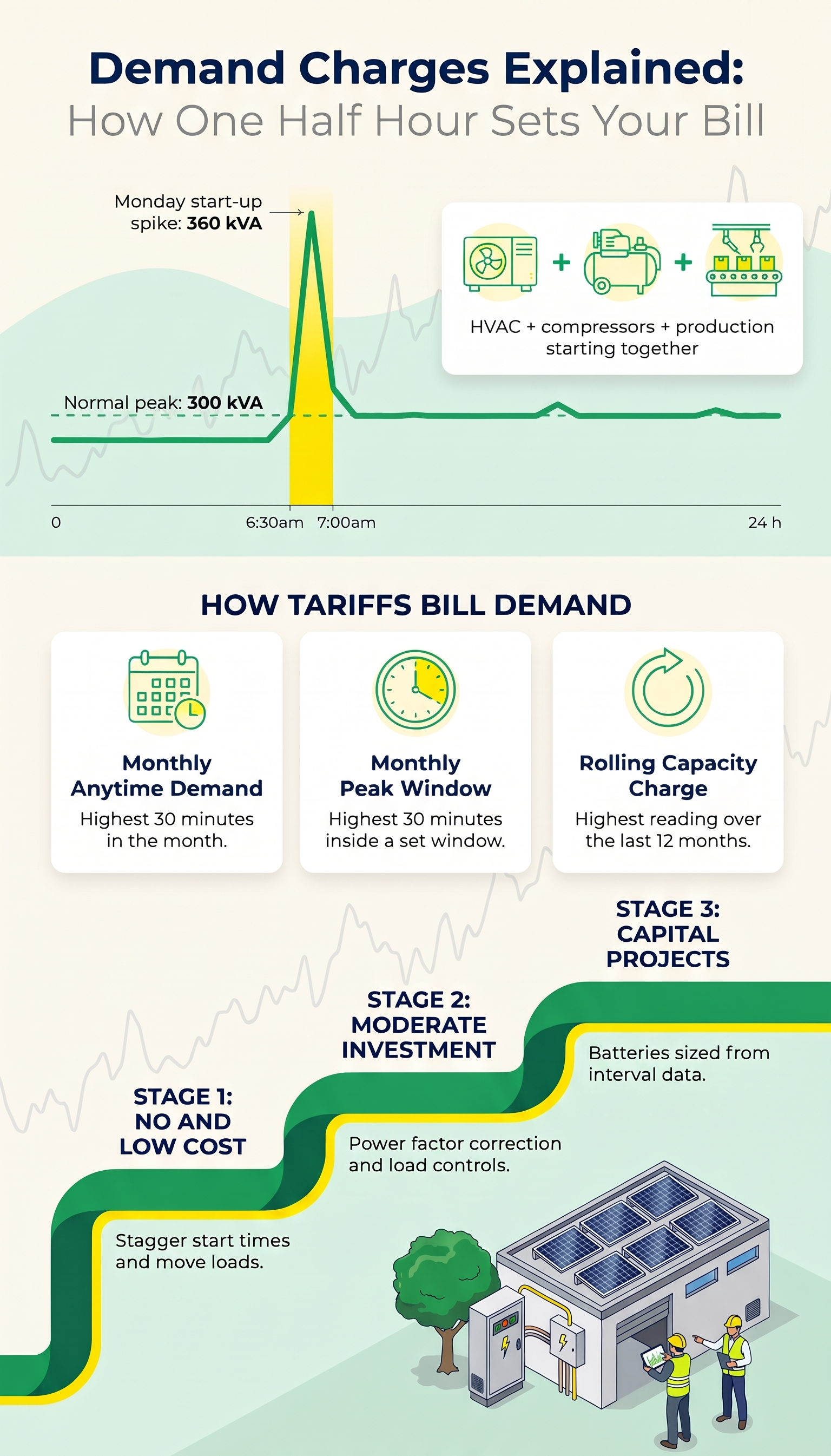
Monthly Anytime Demand
You pay for the highest 30 minute demand recorded in the month, whenever it occurs. The Energex Small Demand tariff works this way, measured in kVA.
Monthly Peak Window Demand
You pay for the highest 30 minute demand inside a set window each month. The Energex Large Time of Use Demand and Energy tariff charges peak demand on weekdays from 5pm to 8pm and off-peak demand from 11am to 1pm.
Rolling Capacity Charges
Some networks set a capacity charge from the highest demand recorded over the previous 12 months. Ausgrid, for example, bases the capacity charge on several of its larger business tariffs on the highest half hour reading between 3pm and 9pm on working weekdays over the previous 12 months. On these tariffs, one bad half hour in January can still be on your bill the following December. Monthly demand tariffs reset each month instead.
Networks update their tariffs each 1 July. The Energex examples above are from its Network Tariff Guide for 1 July 2026 to 30 June 2027.
kW or kVA. Why Power Factor Matters
Some tariffs charge demand in kW. Many charge it in kVA. The difference comes down to power factor.
kW is real power. It is the power that does useful work, such as turning a motor or running a chiller.
kVA is apparent power. It includes real power plus reactive power, which equipment such as motors and compressors draw but does not turn into useful work.
Power factor is the ratio of kW to kVA. A power factor of 1.0 means no wasted capacity. Many sites with large motor loads run well below that.
Here is what that means for your bill. A site drawing 300 kW at a power factor of 0.80 registers 375 kVA of demand. The same site at a power factor of 0.95 registers about 316 kVA. That is 59 kVA less billed demand for the same work.
Power factor correction equipment can close that gap, but whether it saves money depends on your tariff. It only reduces a demand charge that is billed in kVA. The right equipment also depends on your existing installation, your load profile and how much correction the site needs, so have it assessed before you buy anything. A low power factor does not guarantee a saving on its own.
What Causes Demand Peaks on Site
Peaks rarely come from one piece of equipment. They come from loads that overlap. Common patterns on commercial and industrial sites include:
Everything starting at once at the beginning of a shift, including HVAC, air compressors, lighting and production lines
Chillers running at full load on hot afternoons, often inside the network peak window
Batch processes such as ovens, kilns, furnaces and welders running at the same time
Refrigeration defrost cycles and hot water heating that line up by default
Fleet vehicles returning at the end of the day and all plugging in to charge at once
Leaking compressed air systems that force an extra compressor online, as covered in our article on compressed air audits
None of these show up on a monthly bill. They show up in interval data, which records your site's demand every 30 minutes.
A Worked Example
The figures below are illustrative, to show how the maths works. They are not from a client site.
A manufacturing site normally peaks at 300 kVA. On Monday mornings, the HVAC system cools the building before opening, two air compressors start and the production line powers up, all between 6:30am and 7:00am. That overlap pushes one 30 minute average to 360 kVA.
The example assumes the extra 60 kVA is billed at $15 per kVA per month. On a monthly anytime demand tariff, that adds $900 to that month's bill. On a tariff that carries the highest demand forward for 12 months, the same 60 kVA could cost $900 a month for a year, or $10,800. Rates and rules differ by network, so check the demand rate on your own bill.
The fix may be as simple as staggering the start sequence by 30 minutes in the building management system. Check that the change does not create a new peak in another half hour.
Matching the Fix to the Peak
Each kind of peak points to a different place to look:
A demand spike early in the morning: check HVAC, compressors and production starting together. Possible response: stagger start times.
A peak in the late afternoon: check HVAC, refrigeration or vehicle charging overlapping. Possible response: reschedule loads that can move.
High kVA compared with kW: check power factor and reactive load. Possible response: assess power factor correction.
A new peak after adding electric vehicles: check charging schedule against site demand. Possible response: managed or staggered charging.
Short high load periods that keep recurring: check equipment operation and process timing. Possible response: load controls or changes to operations.
Treat these as starting points for investigation. The interval data tells you which one applies.
Practical Ways to Reduce Demand Charges
Start with the options that cost least. Many sites cut their peak without spending capital.
No Cost and Low Cost Changes
Stagger the start times of large loads so they do not overlap in the same half hour
Move batch processes, early cooling and hot water heating outside the network peak window
Review building management system schedules and setpoints against actual occupancy
Schedule electric vehicle charging overnight or across staggered start times
Fix compressed air leaks so fewer compressors run at once
Moderate Investment
Power factor correction, if your demand is charged in kVA and an assessment supports it
Variable speed drives on pumps and fans, so motors ramp up instead of running flat out
Load management controls that shed or delay loads that can wait as demand approaches a set limit
Capital Projects
Battery storage can shave peaks, but whether it pays depends on how high, how long and how often your peaks are. Size it from your interval data and your operating needs, not from a standard product size, and compare it with the cheaper options above first.
Solar PV reduces demand only when it generates during the half hours that set your charge. Output falls in the late afternoon and on cloudy days, so if your peak window runs from 5pm to 8pm, solar alone may do little for your demand charge.
Commercial Checks
Confirm your site is on the most suitable network tariff for its load profile. Ask your retailer which alternatives apply to your connection.
Check that the demand figures on your bill match your interval data.
Why Interval Data Comes First
Most commercial and industrial sites have an interval meter. Your retailer or network can usually supply 12 months of its data against your National Meter Identifier (NMI).
That data shows the exact half hours that set your demand charge. Matching those intervals to what was running on site is where the savings come from. Our article on turning energy audit data into actionable insights explains how that analysis works.
What an Energy Audit Delivers on Demand
A commercial and industrial energy audit treats demand as its own cost line, separate from energy use. For demand, a well scoped audit gives you:
A load profile analysis showing when your peaks occur and which equipment causes them
A review of your tariff against your load profile
A power factor check where you are billed in kVA
A ranked list of demand reduction measures with estimated cost, saving and payback
A view on whether battery storage or solar would reduce your demand charge, based on your actual peak window
The level of detail depends on the audit type. Our guide to AS/NZS 3598 energy audit types explains the difference between a Type 1, Type 2 and Type 3 audit. For a breakdown of the report itself, see what you receive from a commercial energy audit.
Frequently Asked Questions
What is a demand charge on my electricity bill?
A demand charge is a network charge based on the highest rate at which your site draws power, usually averaged over 30 minutes. It is separate from the charge for total energy used.
Is demand measured in kW or kVA?
It depends on your network tariff. Some tariffs use kW, which is real power. Many use kVA, which also counts reactive power, so a poor power factor increases your billed demand.
Can one spike affect my bill for a whole year?
Only on some tariffs. Where a capacity charge uses the highest demand over the previous 12 months, a single peak can stay on your bill until it rolls out of that period. Monthly demand tariffs reset each month.
Will solar panels reduce my demand charges?
Sometimes. Solar reduces demand only when it is generating during the half hours that set your charge. If your peak falls in a late afternoon or evening window, solar alone may have little effect, and load shifting or battery storage may do more.
How do I find out when my peak demand happens?
Request 12 months of interval data from your retailer or network, then match the highest intervals to site operations. An energy audit does this analysis for you and links each peak to its cause.
Next Step
If your bill shows a demand or capacity charge and you do not know what sets it, request a commercial energy audit. We will analyse your interval data, find the half hours that drive your charge and show you which changes to make first.