Decarbonisation Pathways for Commercial and Industrial Sites
Most building owners and site managers know they need to reduce emissions. Fewer know where to start. And almost none know in what order to move.
Decarbonisation is not a single project. It is a sequence of decisions made over years, each one affecting the cost and complexity of the ones that follow. Getting that sequence wrong does not just waste money. It can lock in the wrong infrastructure or force expensive rework down the line.
A commercial energy audit is the tool that turns a broad decarbonisation intention into a practical, site-specific pathway. This post explains how that works.
Why Sequencing Matters
Decarbonisation measures are not interchangeable. Some deliver fast payback with minimal disruption. Others require significant capital, coordination with tenants, or changes to core operating systems.
If you install a heat pump before you have addressed building fabric, you are sizing equipment for a load that could have been smaller. If you commit to a gas-free plant room before you have assessed whether your electrical infrastructure can carry the additional load, you face a second round of capital expenditure to upgrade switchboards and cabling.
Sequencing is not a planning formality. It is a direct cost control lever. The right order reduces total project cost and avoids stranded assets.
This is why the audit comes first. It gives you the data to sequence decisions rationally, not reactively.
What an Energy Audit Establishes
Before a pathway can be built, you need a clear picture of where energy is consumed and what is driving that consumption.
An energy audit conducted to AS/NZS 3598 establishes:
The building or site baseline. Total energy use, cost, and emissions intensity.
Consumption breakdown by system. HVAC, lighting, process loads, hot water, compressed air, refrigeration, and other end uses.
Operational patterns. When loads are highest, how equipment is controlled, and where waste occurs.
Equipment condition and age. What is approaching end of life and when replacement decisions will be required.
Emissions profile. Scope 1 and Scope 2 contributions from gas, diesel, and electricity.
From this baseline, the auditor identifies specific improvement measures, estimates indicative savings and costs for each, and groups them into a prioritised list. That list becomes the foundation of the decarbonisation pathway.
For more on how audit findings are structured into a roadmap, see our earlier post onhow energy audit findings turn into a decarbonisation roadmap.
Common Pathway Categories
While every site is different, most commercial and industrial decarbonisation pathways draw from a similar set of measure categories.
Lighting and Building Controls
These measures are typically the lowest-cost entry point. LED lighting upgrades and improved building management system controls rarely require shutdown coordination, deliver measurable savings within the first billing cycle, and free up cash flow to fund larger capital works later.
They also improve the accuracy of your baseline data, which makes subsequent planning more reliable.
HVAC and Cooling
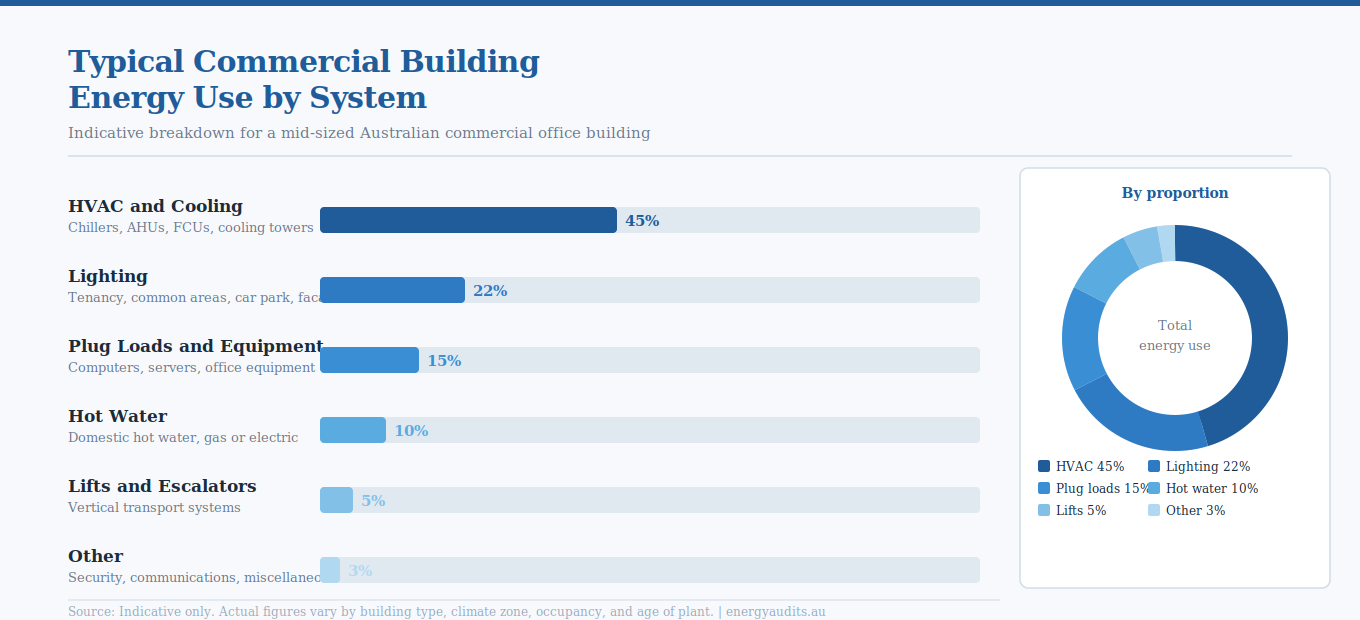
Heating, ventilation, and air conditioning typically accounts for 40 to 60 percent of total energy use in commercial office buildings. Audit findings in this area often include oversized plant, poor zoning, inefficient chiller operation, and outdated controls.
Addressing HVAC efficiency before replacing gas-fired plant avoids over-sizing replacement equipment and reduces the capital needed for electrification.
Fuel Switching and Electrification
Many commercial buildings and industrial sites still rely on gas for space heating, hot water, and process heat. Moving away from gas is one of the highest-impact decarbonisation steps available. It is also one of the most complex.
An indicative example: a mid-sized commercial office building consuming [X] GJ of gas per year for heating and hot water. An audit identifies that HVAC efficiency measures can reduce that load by [X] percent before any fuel switch occurs. This reduces the size of the heat pump system required, which reduces capital cost and simplifies electrical infrastructure upgrades.
The audit tells you what the post-efficiency load will be. That number drives the electrification specification. Without it, you are guessing at equipment sizes and capital budgets.
Process and Industrial Loads
For industrial and manufacturing sites, decarbonisation pathways extend into process heat, compressed air, refrigeration, and production equipment. These systems carry operational risk that commercial buildings do not. Shutdown constraints, process dependencies, and product quality requirements all affect what measures are feasible and in what order they can be implemented.
The audit accounts for these constraints. It identifies opportunities within the operational envelope of the site, not just in theory.
How the Pathway Is Structured
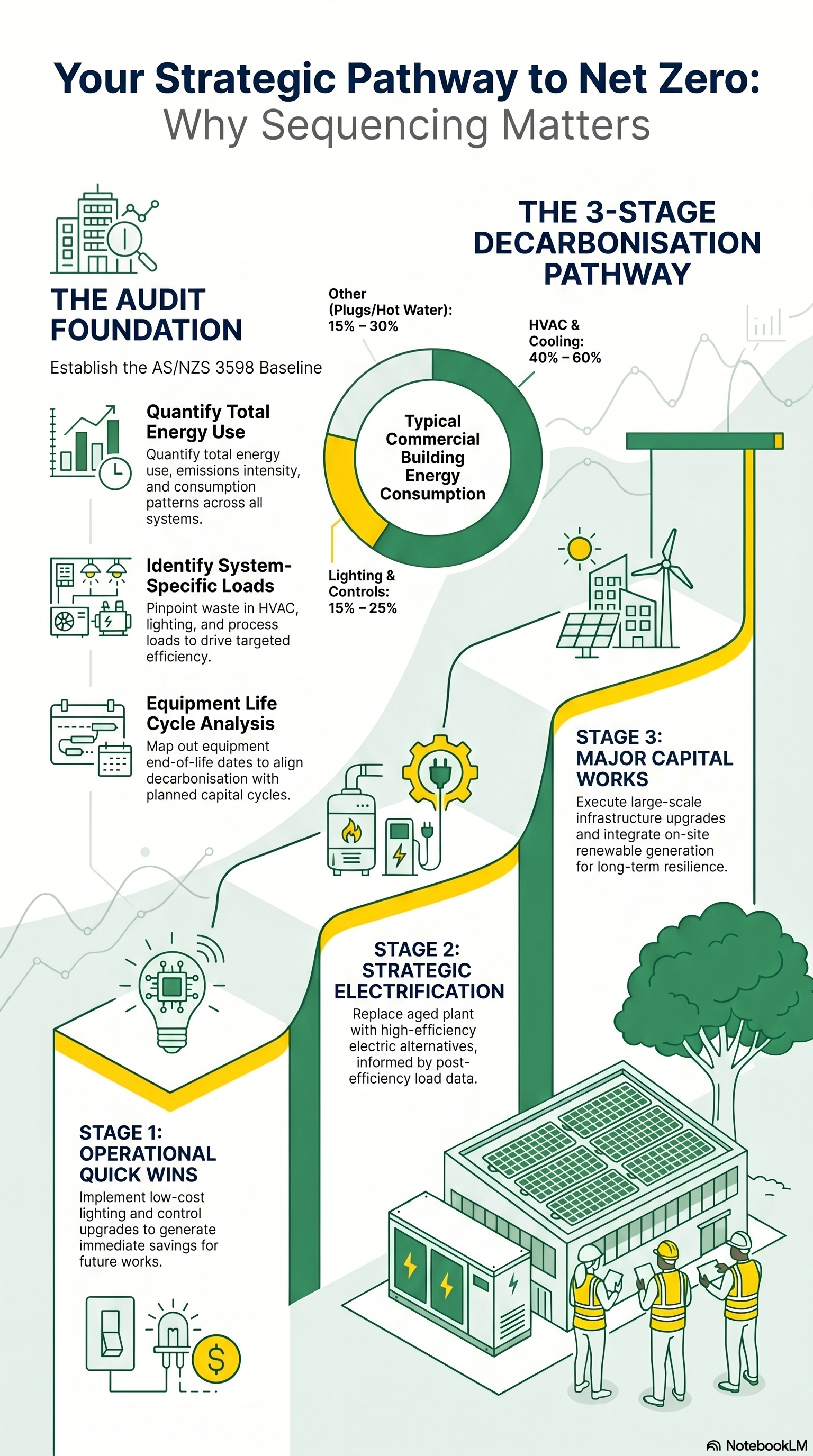
A well-constructed decarbonisation pathway typically moves in three stages.
The first stage covers low-cost, high-return operational improvements. Lighting, controls, HVAC tuning, and energy monitoring. These are implemented within the current capital cycle and generate savings that can be directed toward larger works.
The second stage addresses equipment replacement at end of life. Rather than replacing like-for-like, audit findings inform the specification of new plant. This is where electrification decisions are made, and where fuel-switching infrastructure is designed.
The third stage covers major capital works. Electrical infrastructure upgrades, large-scale plant replacement, and integration with on-site generation where appropriate.
This staging approach avoids forcing decisions before the business case is clear, and avoids committing capital to measures that a later step would make redundant.
For a detailed look at how audits help prioritise early-stage upgrades, see our post onusing energy audits to prioritise decarbonisation upgrades.
The Link to NABERS
For office buildings subject to the Commercial Building Disclosure scheme, decarbonisation planning and NABERS improvement often run in parallel. An audit that identifies energy reduction opportunities also supports improvement in your NABERS Energy rating.
Preparing your building for a NABERS improvement involves many of the same steps as building a decarbonisation pathway. The audit is the common starting point. For more on that process, see our post on preparing a building for a NABERS rating improvement.
Commercial Implications
Decarbonisation carries commercial weight beyond energy cost savings.
Asset value. Buildings with strong energy performance are increasingly preferred by institutional tenants and attract premium valuations in the market.
Tenant retention. Occupiers with their own emissions targets are making lease decisions based on base building performance.
Risk management. Stranded asset risk is real. Buildings that require significant energy upgrades to remain lettable represent a balance sheet exposure that an audit can help quantify and plan for.
Capital planning. A staged pathway gives finance teams a multi-year view of energy-related capex, which improves budget certainty and enables better approval processes.
None of this can be planned without first knowing what the building or site actually consumes. The audit is how you get that visibility.
Start With a Commercial Energy Audit
A decarbonisation pathway is only as reliable as the data behind it. If you are planning energy upgrades or building a business case for capital investment, a structured audit gives you the baseline, the measure list, and the sequencing logic you need.
Learn more about our commercial energy audit services, or contact us to discuss your site.
For a broader overview of what an audit involves, visit our commercial and industrial energy audits pillar page.
