If you are approving a budget or preparing a business case, the first questions about an energy audit are how much it will cost and what drives the price.
This guide explains how energy audit pricing works in Australia. It is written for CFOs, asset managers and facility managers who need a clear scope before committing budget.
What an Energy Audit Typically Costs
As a guide, our audit fees for commercial and industrial sites usually fall into these ranges:
Small and medium commercial buildings: $5,000 to $12,000
Large commercial buildings or small portfolios: $12,000 to $30,000
Industrial or complex manufacturing sites: $20,000 to $60,000 or more
These are indicative ranges from our own work, not Australian market averages, and other providers price differently. Your fee depends on the scope, the site and the decision the audit needs to support. The six factors below explain what moves it.
What You Are Paying For
An audit is a structured investigation of how your site uses energy, where it wastes energy and what you can realistically change. A typical audit includes:
Site inspections and plant walkthroughs
Analysis of 12 months of electricity and gas data
Load profiling and a review of peak demand
Assessment of the main energy using systems in scope, such as HVAC, lighting, process loads and controls
A ranked list of opportunities with cost, saving and payback
A report your finance team can use to approve spend
Some scopes need more. Temporary metering or data logging, a specialist engineering assessment of one system, or detailed financial modelling for a capital approval usually add to the fee. What the auditor can assess also depends on the data you can provide.
For a section by section view of the report itself, see what you receive from a commercial energy audit.
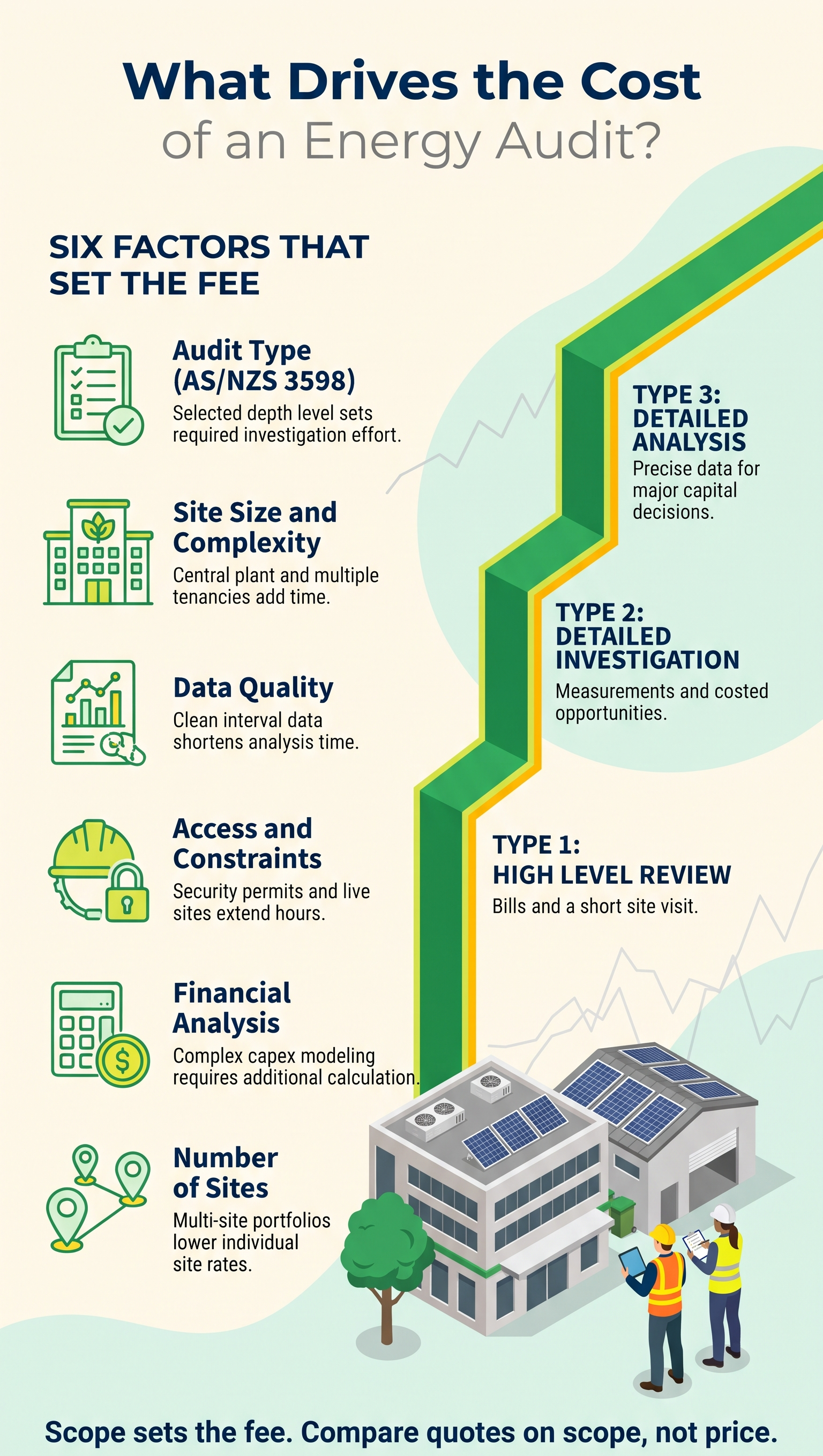
The Six Factors That Drive Price
1. Audit Type Under AS/NZS 3598
AS/NZS 3598 sets three audit types. They differ in how deeply they investigate and in the decisions they are built to support.
Type 1 is a high level review of bills with a short site visit. It shows where energy is broadly used and whether a deeper audit is justified. It is not enough on its own to support a capital approval.
Type 2 is a detailed site investigation with measurements and costed opportunities. It is the most common audit type for commercial buildings.
Type 3 is a detailed analysis, often of a major subsystem such as boilers, refrigeration or compressed air, measured to a higher level of accuracy. It is used where a large capital decision depends on the result.
The right type depends on the decision, the complexity of the site and how much confidence the approver needs. As an example of matching depth to risk, a Type 1 audit is unlikely to give enough confidence to approve a $2 million plant upgrade. Our guide to AS/NZS 3598 audit types explains each level in more detail.
2. Size and Complexity of the Site
Floor area matters, but complexity matters more. A 20,000 square metre office with central plant, several tenants and use after hours can cost more to audit than a larger, simpler warehouse. Cost rises when a site has:
Multiple buildings or meters
Central chilled water or boiler plant
Process loads or production equipment
Mixed tenancies or extended operating hours
3. Data Quality
Good data shortens the audit. If your site has 12 months of clean interval electricity data, clear gas bills and some submetering, the auditor spends less time rebuilding your usage patterns. If data is missing or split across accounts, that extra work shows up in the fee. Our article on turning energy audit data into actionable insights explains how auditors use it.
4. Access and Operational Constraints
Live sites cost more to audit. Time on site goes up when equipment cannot be shut down, access is limited to certain hours, or inductions and permits are required. Manufacturing sites often fall into this group, because the audit has to work around production.
5. Depth of Financial Analysis
Some audits identify opportunities. Others justify spending. Costs rise when the report needs quantified savings with stated assumptions, capex estimates, cash flow impacts and staged implementation options. Finance teams usually need this level of detail to approve capital.
6. Number of Sites
Portfolio audits cost more in total but often less per site, because the method, templates and reporting are set up once and repeated.
What to Prepare Before You Ask for a Quote
A provider can scope and price an audit more accurately when you send:
12 months of interval electricity data from your retailer, with your National Meter Identifier (NMI)
12 months of electricity and gas bills
A list of sites, with floor areas and operating hours
A list of major plant, such as chillers, boilers, compressors and refrigeration
The decision the audit needs to support, such as a capital approval, a grant application or a net zero plan
How to Compare Energy Audit Quotes
Quotes often differ because they cover different scopes. Ask each provider the same questions:
Audit type and standard: Which audit type is proposed, and what does it cover?
Site coverage: Which buildings, meters and systems are included?
Data analysis: Which energy data and periods will be analysed?
Site access: How many visits, and what operational access is included?
Measurements: Is temporary or specialist metering needed, and is it in the price?
Recommendations: Will each opportunity include cost, savings assumptions and payback?
Financial analysis: Will the report support a capital approval?
Exclusions: What is specifically excluded from the fee?
Deliverables: What report, presentation or data will you receive?
Not every audit includes every item. These questions show where two quotes differ, so you compare like with like.
Two Example Scenarios
These scenarios are indicative. They show how scope changes cost. They are not quotes and not client results.
A medium CBD office. Central HVAC, a stable tenancy and good billing data. The audit focuses on energy use after hours, HVAC scheduling and lighting controls. An indicative fee is $8,000 to $12,000.
A food processing site. Refrigeration, compressed air and gas process heating. The audit focuses on base load, peak demand charges, process equipment and heat recovery. An indicative fee is $25,000 to $45,000. Process sites often need more complex investigation, and what each opportunity is worth depends on operating hours, energy use, equipment and project economics.
Is the Cheapest Quote the Best Value?
Not always. A lower fee can reflect a smaller site, simpler systems, better data or a narrower scope. It can also mean less time on site, general assumptions or little financial analysis. Compare what each quote includes and excludes, how the work will be done, and whether the report will support the decision you need to make.
Can a Grant Cover the Cost?
Possibly. Some state programs have funded audits, net zero plans or feasibility studies, and some grants ask for an audit or a costed quote with the application. Eligibility, funding limits and timing vary, and programs open and close often. Check our grants page for current programs before you plan around one.
How to Approach Budget Approval
Before you approve a budget, answer three questions:
What decisions will this audit support?
What risks does it need to reduce?
What level of confidence does the approver need?
Frequently Asked Questions
How much does a commercial energy audit cost in Australia?
Our indicative fees run from about $5,000 for smaller commercial buildings to $30,000 for large buildings and small portfolios, and $60,000 or more for complex industrial sites. The fee depends on the audit type, site complexity, data quality and the depth of financial analysis you need.
What is the difference between a Type 1, Type 2 and Type 3 audit?
They are the three levels in AS/NZS 3598. Type 1 is a high level review, Type 2 is a detailed site investigation with costed opportunities, and Type 3 is a detailed analysis, often of a major subsystem such as boilers or compressed air, for large capital decisions.
How long does an energy audit take?
It depends on the audit type and the site. Ask each provider for a timeline based on your scope. Having your interval data ready before the audit starts shortens it.
Is an energy audit worth the cost?
It is worth it when the audit is scoped to a real decision. A good audit shows which upgrades pay back, in what order, and which ones to skip.
Next Step
If you are trying to confirm budget, scope or audit depth, request an energy audit. We will talk through your site, your constraints and the decision you need to make, and recommend the level of audit that fits before you commit to spend.