What You Receive From a Commercial Energy Audit
A commercial energy audit is not a single report. It is a set of practical outputs designed to help you control costs, reduce risk, and plan upgrades with confidence.
If you manage or oversee a commercial or industrial site, the value is clarity. Clear data. Clear priorities. Clear next steps that fit real site constraints.
This article explains what you actually receive from a commercial energy audit in Australia, and how those deliverables are used in practice.
Why audit deliverables matter
Most sites already know energy is an issue. Bills increase year on year. Equipment ages. Controls drift. Changes get made over time without a full picture.
An energy audit turns that situation into structured information you can act on.
The deliverables are designed to answer three practical questions.
Where is energy actually being used?
What can be fixed with low disruption?
What investments are worth planning and when?
Core deliverables you should expect
Every commercial energy audit should include the following outputs, regardless of audit level.
Site energy overview
You receive a clear summary of how energy is used across the site.
This usually includes:
Electricity and gas consumption by month.
Annual energy cost by fuel type.
Key tariff drivers, such as demand charges.
This section sets context. It explains why certain systems matter more than others.

Interval data and load profile analysis
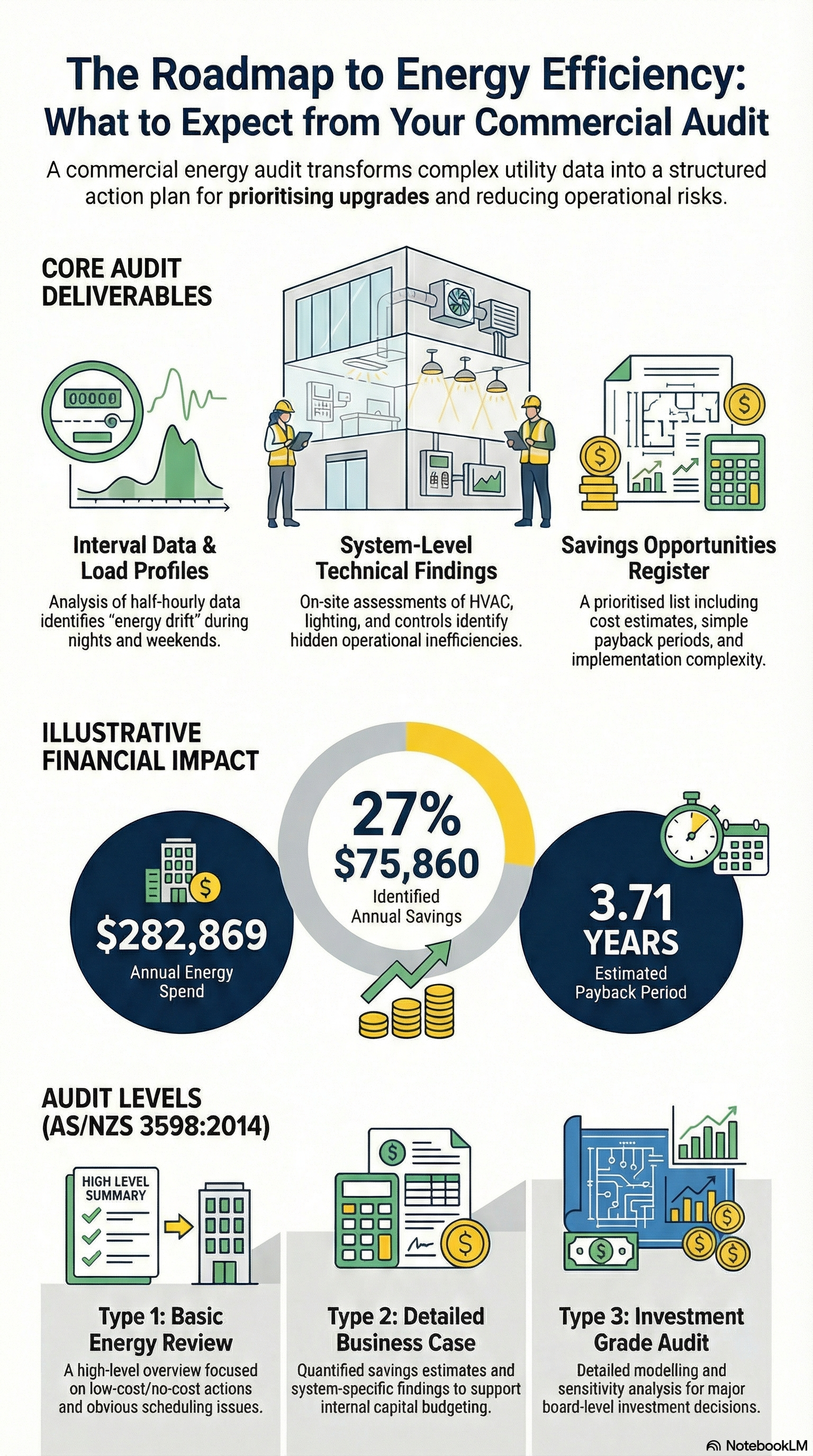
Where interval data is available, the audit analyses half-hourly or fifteen-minute data.
This shows:
Typical daily load profiles.
Base load during nights and weekends.
Demand peaks that drive network charges.
This analysis often identifies savings before any equipment is replaced. After-hours operation and poor scheduling are common findings.
System-level findings based on site reality
Auditors assess how systems actually operate on site, not how drawings say they should operate.
Systems commonly reviewed include:
HVAC plant and controls.
Lighting systems and controls.
Hot water systems and boilers.
Refrigeration in hospitality and food sites.
Compressed air in industrial facilities.
Findings focus on control issues, operating hours, plant condition, and interaction between systems. The aim is practicality, not theory.
For facility managers, this is where the audit is most useful. Many sites carry ageing plants that have been patched and adjusted over the years. Controls may have been overridden during a breakdown and never reset. Contractor work has been done in stages without a view of the whole system. The audit surfaces these issues in a structured way, so you can prioritise what to address and in what order.
Findings are also framed with access and operational constraints in mind. Recommendations that require extended shutdowns or complex contractor coordination are noted as such, so you can plan realistically rather than discover that during implementation.
Savings opportunities register
You receive a structured list of opportunities. This is one of the most used audit outputs.
Each item typically includes:
A clear description of the issue.
Indicative annual energy savings.
Indicative cost range.
Simple payback estimate.
Implementation complexity or disruption notes.
This allows you to prioritise actions without relying on gut feel, and communicate clearly with contractors and budget holders about what is involved.
To illustrate the kind of outcome a well-structured savings register supports:
Medium-sized commercial site. Annual energy spend of $282,869. The audit identified $75,860 in annual savings, representing a 27% reduction. Payback period of 3.71 years. Carbon reduction of 160 tonnes.
How deliverables differ by audit type
The structure of deliverables stays consistent, but depth increases with audit level.
Type 1 energy audit deliverables
Type 1 audits provide a high-level overview.
You typically receive:
Whole site energy summary.
High-level load profile review.
Identification of obvious control and scheduling issues.
Low-cost and no-cost actions.
These audits are suitable for smaller sites or early-stage reviews. They are often used to confirm whether deeper analysis is justified.
Type 2 energy audit deliverables
Type 2 audits are the most common for commercial buildings.
You receive:
Detailed interval data analysis.
System-specific findings for major loads.
Quantified savings estimates.
A prioritised opportunity list.
Indicative inputs for capital planning.
This level supports internal budgeting, business case development, and staged planning.
Type 3 energy audit deliverables
Type 3 audits support major investment decisions.
You receive:
Detailed modelling with stated assumptions.
Higher confidence savings estimates.
Scenario and sensitivity analysis.
Staged upgrade pathways.
Outputs suitable for executive or board review.
These audits are used where decisions involve significant capital or long asset lives.
What different decision makers actually use
Different roles use different parts of the audit.
CFOs and asset managers focus on:
Cost drivers and forecast savings.
Payback periods and risk.
Capital prioritisation across portfolios.
Facility and operations managers focus on:
Control fixes and operational changes that do not require major budget approval.
Maintenance-driven actions that align with scheduled downtime.
Contractor coordination requirements and access constraints for each recommendation.
Reliability risk associated with ageing equipment was flagged in the audit.
Shutdown requirements, so actions can be staged around operational priorities.
A good audit makes these pathways clear. It does not expect every reader to interpret raw data.
How audits support NABERS improvement planning
Energy audits are commonly used to support NABERS improvement plans.
The deliverables help by:
Identifying after-hours energy drift.
Highlighting control and scheduling issues.
Providing evidence to prioritise upgrades.
The audit does not replace NABERS assessments. It informs targeted improvement actions.
What you should not expect from an audit
An energy audit is a decision support tool, not a guarantee.
You should not expect:
Guaranteed savings outcomes.
Final construction designs.
Vendor-specific pricing.
The audit gives you decision-ready information. Implementation still requires site-specific planning, contractor input, and operational coordination.
Where to go next
If you want more details on audit structure, you can review Commercial and Industrial Energy Audits Australia.
If you want to understand audit levels in more depth, see AS NZS 3598 Energy Audits. What Each Level Means On Site.
If you want to discuss whether an audit is suitable for your building, the next step is a scoped conversation.
You can request a commercial energy audit to discuss your site, constraints, and priorities.
Find out about available energy reduction grants and subsidies for your organisation on our Grants page.
