Compressed Air Audits - Air Leaks Audits for Businesses
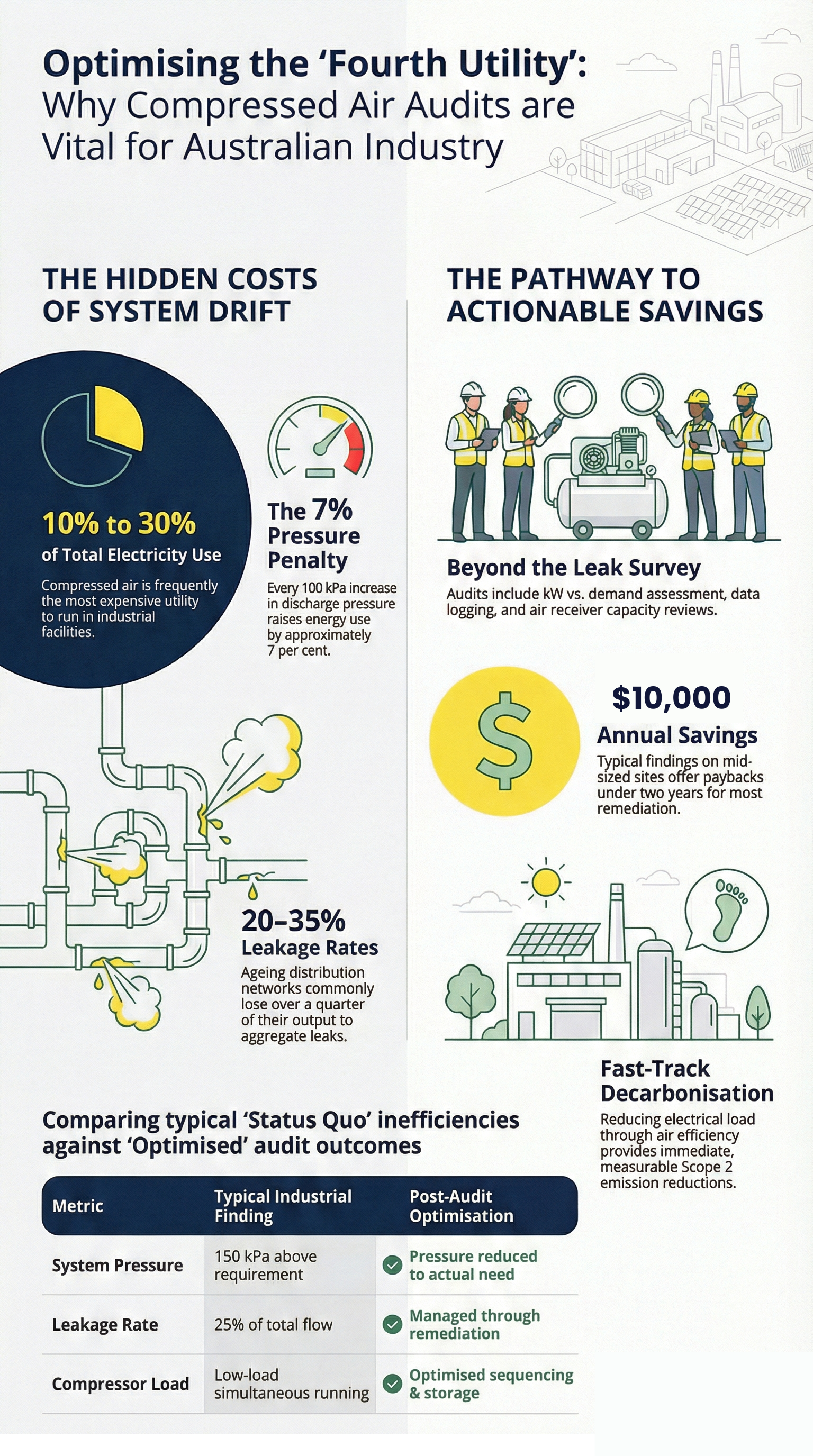
Compressed air is often described as the fourth utility on industrial sites. It is also one of the most misunderstood and expensive systems to run.
In manufacturing, food processing, logistics, and heavy industrial facilities, compressed air can account for 10 to 30 per cent of total electricity use. On some sites, it is higher. Yet it rarely receives the same scrutiny as HVAC or production equipment.
When systems drift, leak, or operate at incorrect pressure, the cost impact is continuous. The production risk can be immediate.
This is where a targeted compressed air energy audit becomes commercially valuable.
Where Compressed Air Systems Lose Money
On most Australian industrial sites, we see three recurring issues: leaks, excessive system pressure, and poor demand control and sequencing.
Leaks are rarely small in aggregate. A single 3 mm leak at 700 kPa can cost thousands of dollars per year in electricity. On large sites with ageing distribution networks, total leakage rates of 20-35% of system output are common.
Excess pressure compounds the problem. Every 100 kPa increase in discharge pressure can raise energy use by around 7 per cent. Many systems run higher than necessary because no one wants complaints from production lines.
Demand control is the third issue. Multiple compressors operating without proper sequencing, inadequate storage, or mismatched compressor types lead to inefficient part-load operation. That means you pay for full-load electricity while delivering fluctuating output.
An energy audit brings structure to what is often managed reactively.
Compressed Air Audit Case Study
A compressed air energy audit often includes a structured leak survey using ultrasonic detection equipment.
On a recent industrial site in New South Wales, a one-day survey identified:
26 active compressed air leaks
3.2 Nm3/min of lost compressed air
91 MWh per annum of wasted electricity
Approximately $19,400 per year in avoidable energy cost
Around 10 per cent of total compressed air demand is attributed to leakage
The combined compressor capacity on that site was 28.57 Nm3/min. Leak losses accounted for a significant share of installed capacity.
The material repair cost was estimated at $1,390 to $3,500, with a simple payback period of under 2 years, excluding labour allocation.
Importantly, no previously tagged leaks were found. This is common on sites where leak management is informal or reactive.
The survey also identified general fittings as the largest leak category, and certain production areas carrying disproportionate leak costs. System pressure was operating at 7.3 bar blanket during inspection.
This type of quantified output allows facility teams to prioritise repairs by cost impact, not guesswork.
What a Compressed Air Energy Audit Actually Involves
A proper compressed air audit is not just a leak survey.
A leak survey is one component of the audit, focused specifically on identifying and quantifying distribution losses.
A full compressed air energy audit typically includes:
Review of compressor types, age, and control strategy
Assessment of installed kW versus site demand
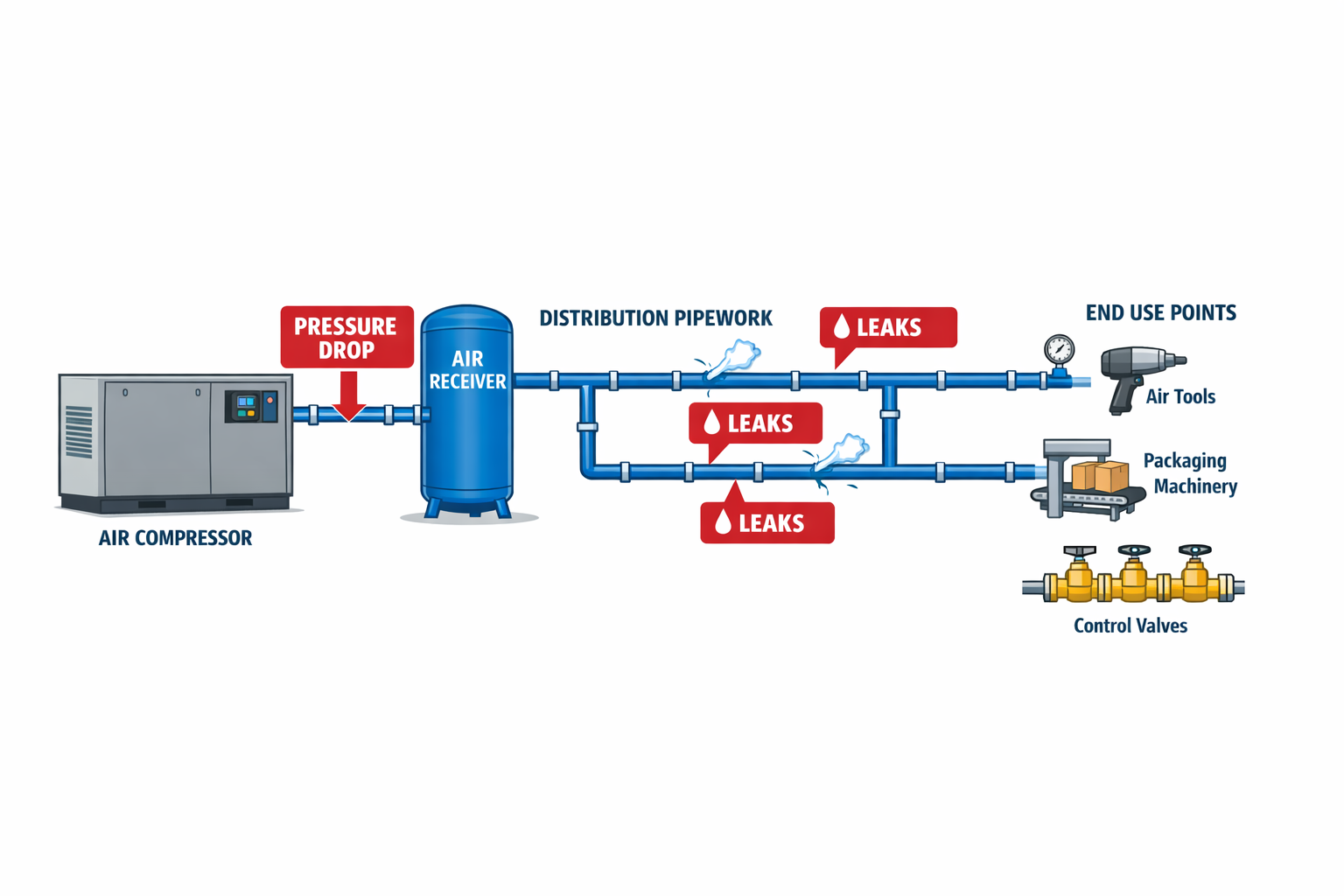
Pressure setpoint analysis and drop across the network
Data logging of load and unload cycles
Leak detection during production and non-production hours
Review of air receivers and storage capacity
Assessment of dryers, filters, and ancillary loads
On many sites, interval electricity data is also used to correlate compressor load with production shifts.
The outcome is not just a list of leaks. It is a system-level understanding of pressure stability, redundancy, and true demand profile.
If you want a broader understanding of how industrial audits are structured, see our guide to Commercial and Industrial Energy Audits in Australia.
Pressure, Production Risk and Hidden Demand
Operations teams often prioritise stability over efficiency. That makes sense. If air pressure drops below the required levels, valves fail, actuators slow, and packaging or machining lines stop. Downtime is expensive.
The result is conservative pressure settings and additional compressors online "just in case".
An audit quantifies this trade-off.
On large industrial sites, this analysis often begins with a compressed air leak survey. These surveys identify where air is escaping from the distribution network and quantify the cost impact of those losses.
Case Example. Large Industrial Manufacturing Site
During a compressed air leak survey at a large manufacturing facility, a one-day inspection identified significant compressed air losses throughout the network.
The site operated two 90 kW compressors with a combined maximum capacity of 28.57 Nm³/min. A systematic ultrasonic leak survey identified 26 individual leaks across production areas and general fittings.
The survey estimated total compressed air loss of approximately 3.2 Nm³/min. This corresponded to approximately 9.6 per cent of the compressor's electricity consumption. The identified leaks were estimated to consume approximately 91 MWh of electricity per year, representing around $19,400 in avoidable energy cost based on the site's electricity tariff.
Importantly, none of the leaks had previously been tagged or tracked as part of a maintenance program.
The estimated material cost to repair all identified leaks was between $1,390 and $3,500, highlighting the relatively low cost of remediation compared with the ongoing energy losses.
Linking Compressed Air to Decarbonisation
Compressed air is an electrical load. Every kWh saved reduces Scope 2 emissions.
For organisations developing decarbonisation plans, compressed air often falls into the short- to medium-term action category. It usually requires lower capital than plant replacement and delivers measurable reductions quickly.
In electrification planning, audits also test whether increased electrical demand from heat pumps or process upgrades will clash with compressor capacity and switchboard limits.
Compressed air is not isolated. It interacts with your broader energy strategy.
If you are reviewing decarbonisation upgrades, our article, "Using Energy Audits to Prioritise Decarbonisation Upgrades," explains how system-level audits inform staging and capital allocation.
Common Constraints on Site
Facility and Maintenance Managers know the realities: ageing pipework with undocumented modifications, shutdown windows limited to weekends, production managers resistant to pressure changes, and a limited budget for full system replacement.
A compressed air audit recognises these constraints. Rather than recommending full replacement as the default, it typically stages improvements: immediate low-cost fixes, medium-term control and storage optimisation, and long-term compressor replacement aligned with the asset lifecycle.
This allows CFOs and Asset Managers to assess capex against quantified savings and risk reduction.
How Compressed Air Audits Fit Into Industrial Energy Reviews
Compressed air is rarely reviewed in isolation. It forms part of a broader industrial audit that may also assess process heating, refrigeration, motors and drives, and demand charges and tariff structure.
If you want to understand how these systems are assessed more broadly, see What an Industrial Energy Audit Typically Identifies.
The key is translation. Data becomes a prioritised savings register, a risk assessment, and a staged investment pathway. Without measurement, compressed air remains a background cost. With proper auditing, it becomes a controllable asset.
Next Step
If compressed air accounts for a material portion of your electricity spend, or if pressure stability is an ongoing operational concern, it is worth properly quantifying the risk.
Contact us to request a commercial energy audit, or get in touch to discuss your site, production constraints, and budget realities.
Find out about available energy saving grants and subsidies for your organisation on our Grants page.
