Common Energy Audit Findings by Industry
Every industry uses energy differently.
Your risk profile is different. Your equipment is different. Your operational constraints are different.
That is why energy audits in Australia cannot rely on generic checklists. They must reflect how your site actually operates.
This article outlines common findings across priority sectors, based on indicative audit experience. These are patterns, not promises. Every site must be assessed individually.
If you are new to the broader structure of commercial and industrial energy audits in Australia, start with our overview of Commercial and Industrial Energy Audits in Australia, which explains the scope, standards, and intent.
Manufacturing Facilities
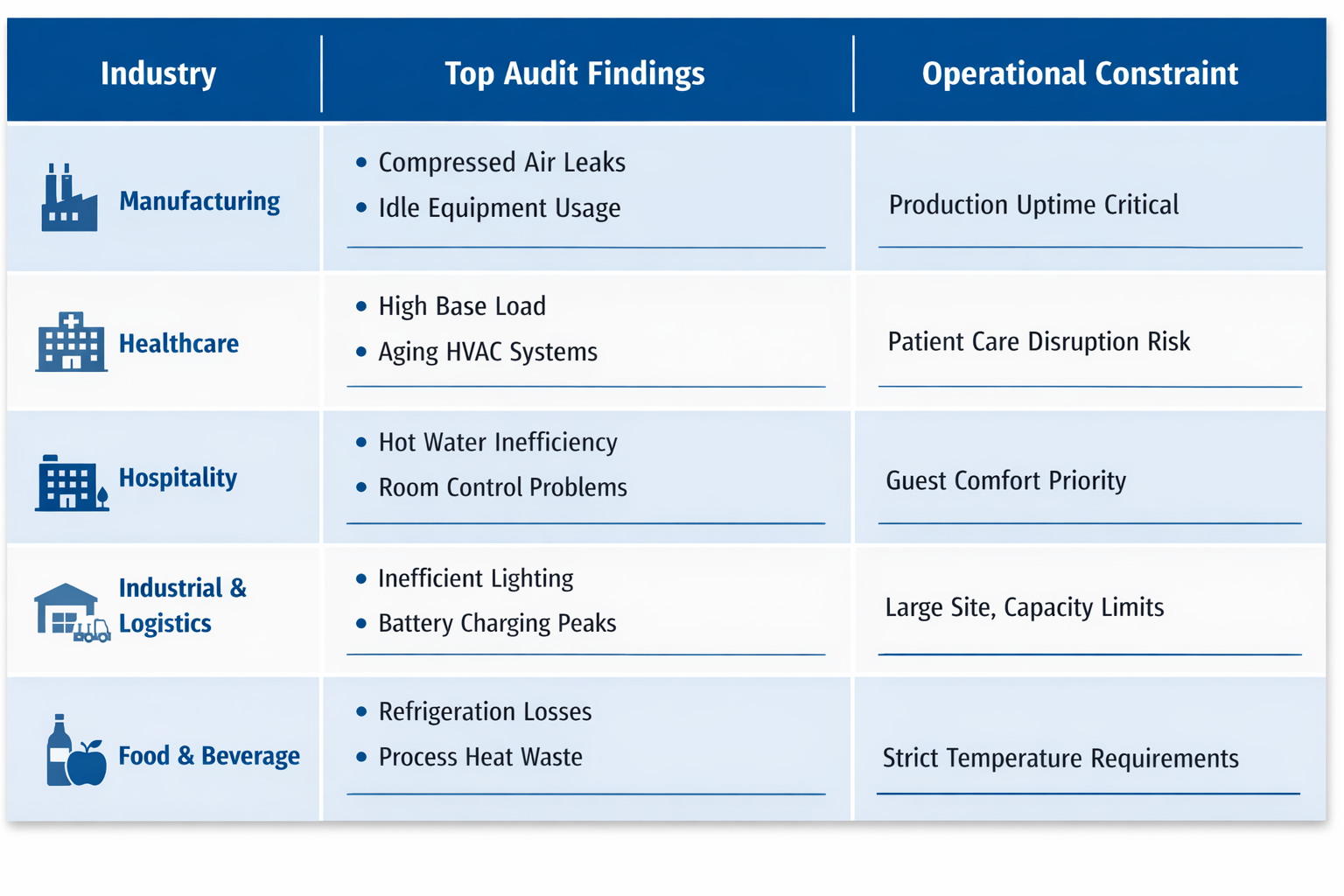
Manufacturing sites often present the highest variability in load profile and the greatest operational risk.
Common findings include:
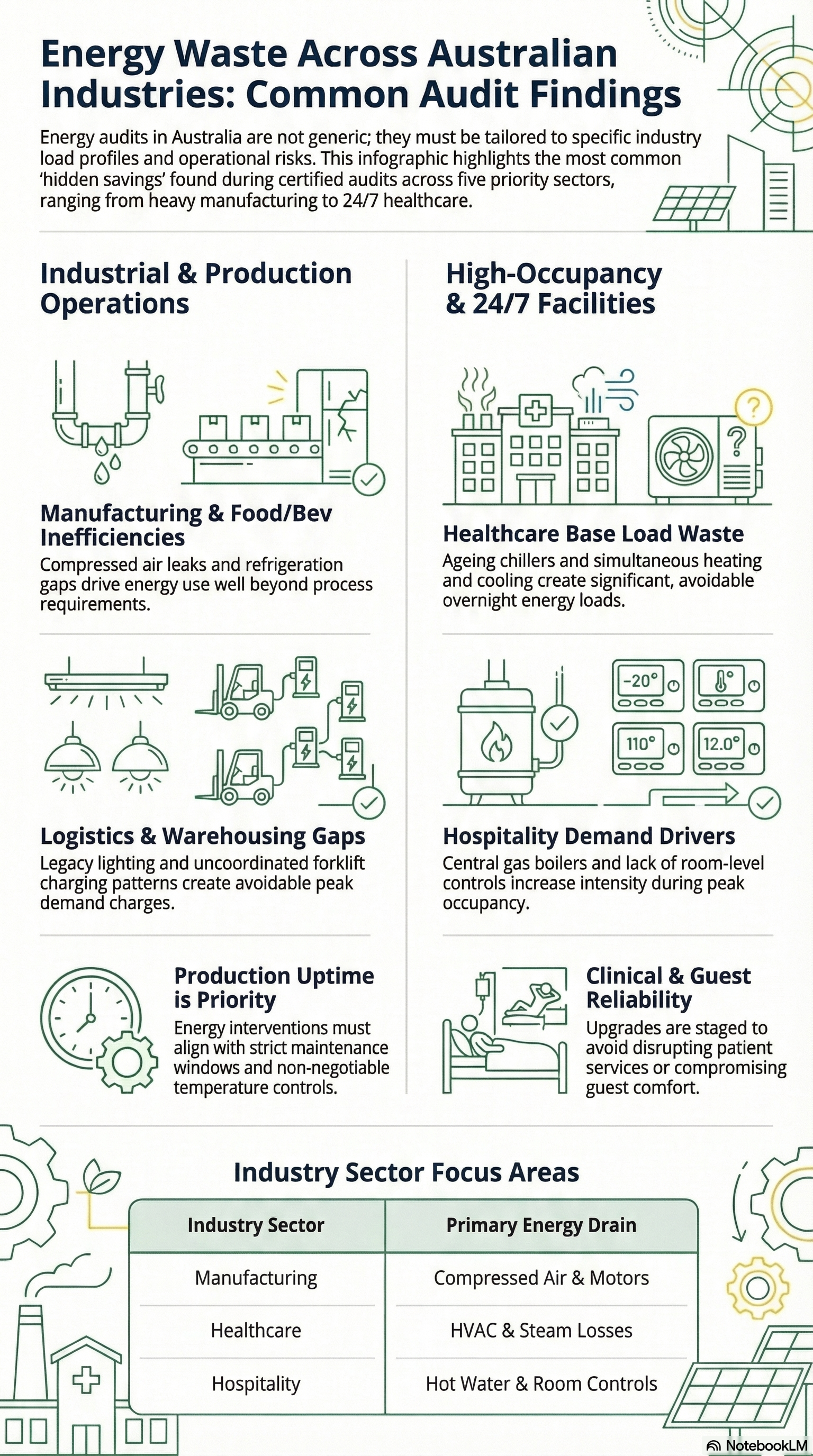
Compressed air inefficiency
Leaks, excessive system pressure, poor sequencing, and uncontrolled demand frequently drive compressor energy use well beyond what the process actually requires. This links directly to the risks outlined in our Compressed Air Energy Audits guide.
Oversized or continuously running motors
Pumps and fans are running at full speed when process demand fluctuates.
Poor shutdown discipline
Plant left energised overnight or during non-production periods.
Reactive power and power factor penalties
Older switchboards and legacy equipment often attract avoidable network charges.
Operational constraint reality: Production uptime takes priority. Any intervention must align with maintenance windows and shutdown schedules.
Healthcare Facilities
Hospitals and private health facilities operate 24 hours per day. Reliability overrides efficiency.
Common findings include:
High base load
Medical equipment, HVAC for infection control, and redundancy systems create a significant overnight load.
Simultaneous heating and cooling
Older air handling systems often heat and cool in adjacent zones due to control logic issues.
Ageing chillers and boilers
A legacy plant that remains operational but inefficient, often with limited spare parts availability.
Steam system losses
In older facilities, steam traps and distribution losses are frequently identified.
Operational constraint reality: Clinical risk tolerance is low. Energy upgrades must avoid disrupting patient services and ensure compliance with accreditation standards.
Hospitality
Hospitality businesses, including hotels and large accommodation facilities, typically operate long hours with highly variable occupancy and mixed energy loads.
Common findings include:
Hot water system inefficiency
Central gas boilers often operate continuously regardless of occupancy.
Laundry and kitchen loads
Commercial kitchens and in-house laundries create concentrated peak demand.
Room-level control issues
Older fan coil units without modern controls increase energy intensity per occupied room.
Excessive ventilation rates
Systems operating beyond design requirements.
Operational constraint reality: Guest comfort and reputation risk shape every decision. Upgrades must be staged carefully to avoid disruption during peak season.
Industrial and Logistics Facilities
Industrial and logistics facilities, including warehouses and distribution centres, typically have lower process loads but higher energy use for lighting and HVAC.
Common findings include:
Lighting upgrades are still incomplete
Large high-bay areas are still using legacy metal-halide fittings.
Poorly zoned HVAC
Heating or cooling entire volumes when only a portion of the volume is occupied.
Battery charging inefficiencies
Forklift charging patterns that drive avoidable demand peaks.
Demand charges
High maximum-demand events triggered by coincident equipment start-ups.
Operational constraint reality: Large roof spans and electrical capacity limits often influence the feasibility of upgrades, particularly for electrification planning.
Food and Beverage
Food and beverage facilities, including cold storage, processing plants and packaging operations, often rely heavily on refrigeration and process heat.
Common findings include:
Refrigeration plant optimisation gaps
Inefficient defrost cycles, floating head pressure not implemented, and ageing compressors.
Insulation degradation
Cold-room door seals and insulation failures are increasing the refrigeration load.
Process heat losses
Steam and hot water losses across production lines.
Compressed air for packaging
High use with minimal leak detection processes.
Operational constraint reality: Temperature control is non-negotiable. Any optimisation must maintain product quality and compliance.
Why Industry Patterns Matter
These findings are indicative. They are not universal.
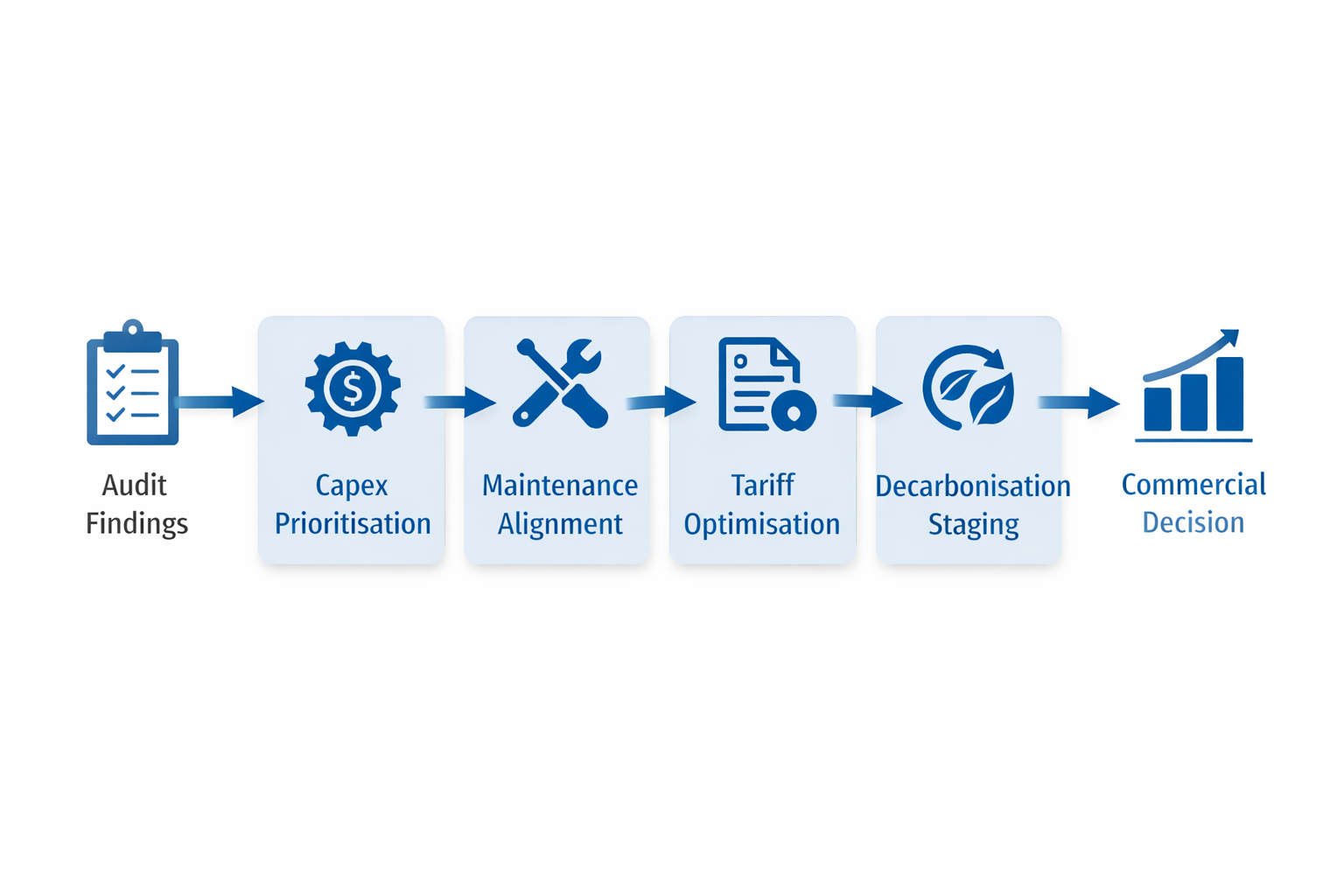
What matters is how these patterns translate into commercial decision-making. A structured audit converts site-specific findings into decisions your team can act on, across capex prioritisation, maintenance alignment, tariff optimisation, and decarbonisation staging.
An energy audit provides structured, site-specific insight. It moves you from assumption to evidence.
From Findings to Action
Industry patterns provide a starting point. Your site data provides the answer.
A structured audit aligned to AS/NZS 3598 identifies where energy is used, what is driving avoidable cost, what upgrades are technically feasible, how changes affect reliability and operations, and what indicative financial outcomes look like.
The value of an audit is not a headline savings number. It is clarity: a clear picture of where your site stands, what the practical options are, and which improvements can be justified commercially.
If you want to understand what the audit deliverables look like in practice, our guide, What You Receive From a Commercial Energy Audit, explains the decision-ready outputs.
For role-specific considerations, Energy Audits for Facility Managers outlines how audit findings integrate with day-to-day operational pressures.
Speak with SolSombra
If you are assessing cost pressure, electrification, or decarbonisation pathways within your industry, speak with us to discuss your site constraints and operational risks.
Request a commercial energy audit and receive evidence you can act on.
Find out about available energy saving grants and subsidies for your organisation on our Grants page.
