How to Evaluate an Industrial Energy Audit Provider
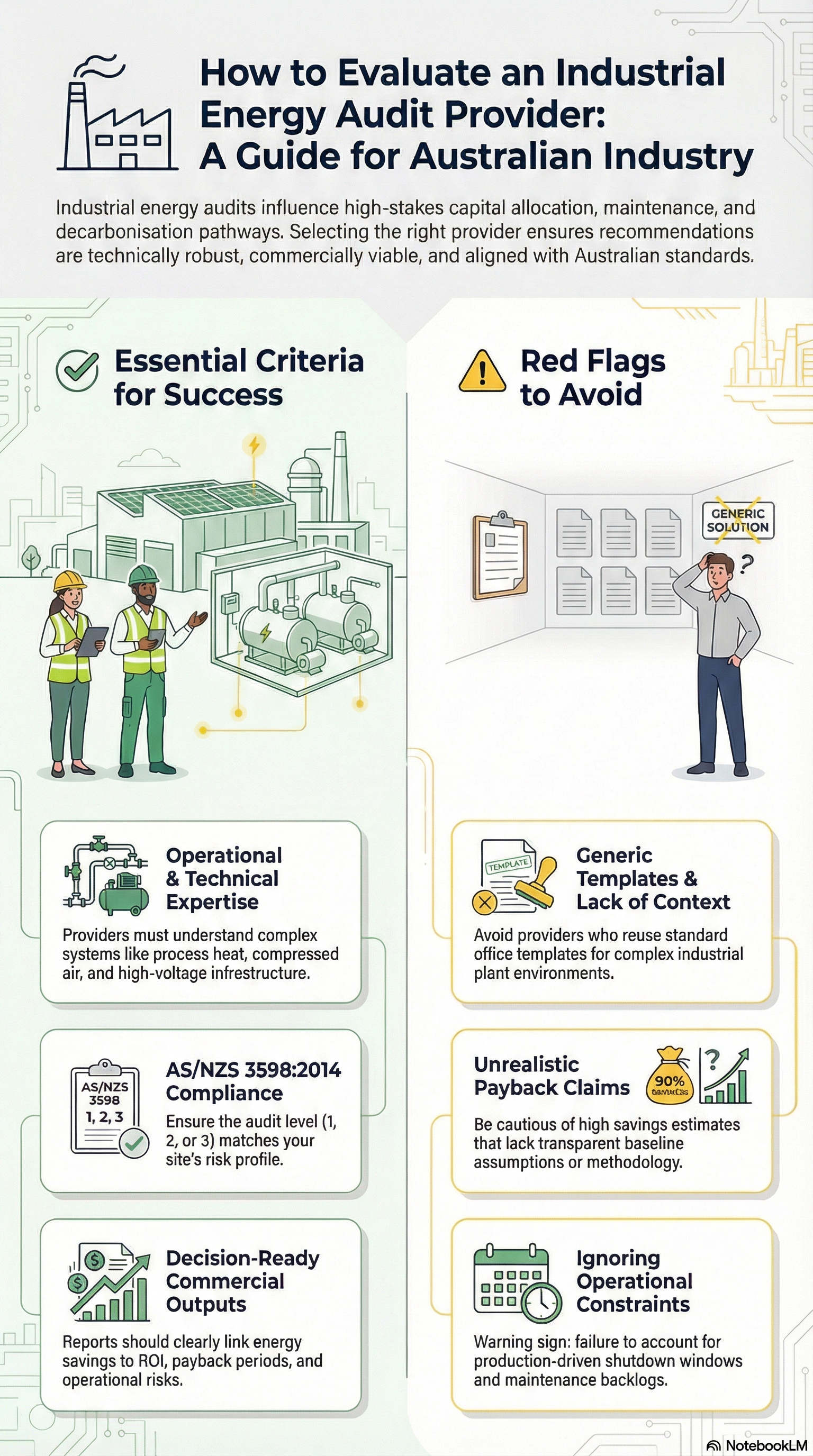
If you are commissioning an industrial energy audit, the quality of the provider will directly influence the quality of your decisions.
On an industrial site, an audit is not a paper exercise. It affects capital allocation, maintenance planning, shutdown coordination, and, in some cases, your decarbonisation pathway. Choosing the wrong provider can lead to weak analysis, unrealistic savings, or recommendations that ignore operational constraints.
This guide explains how to assess an industrial energy audit provider with confidence.
If you are new to the audit process itself, start with our overview of Commercial and Industrial Energy Audits in Australia to understand the scope and intent.
1. Industrial Experience and Why It Matters
Industrial energy audits are rarely generic. Every industry has different equipment, operating patterns, and operational risks.
A provider who understands your sector will recognise major energy drivers quickly. They will know which systems usually dominate consumption and which upgrades are practical for the site.
Industry experience improves three things:
Faster identification of major energy loads
More realistic recommendations
More reliable cost and savings estimates
Below are examples of the types of systems and operational considerations auditors should understand in each sector.
-
Agricultural facilities often have highly seasonal energy demand driven by irrigation, refrigeration, and processing activities. Energy use can vary significantly across harvest cycles, making demand management and pump efficiency particularly important.
Irrigation pumping loads and seasonal demand
Cold storage and refrigeration systems
Long electrical distribution runs across sites
-
Healthcare facilities range from small medical clinics and specialist practices to large hospitals and research facilities. Energy use is typically driven by HVAC requirements, medical equipment, ventilation standards, and strict indoor environment controls.
Medical equipment and diagnostic loads
Ventilation and infection control systems
HVAC reliability and indoor air quality requirements
-
Energy Audits for Manufacturing
Typical knowledge required:
Process heat systems
Compressed air networks
Motor-driven equipment and production scheduling constraints
-
Hotels and accommodation facilities have highly variable demand driven by occupancy and guest behaviour. Hot water, HVAC, laundry operations, and kitchens often account for the majority of energy consumption.
High hot water demand
Kitchen and refrigeration loads
HVAC responding to occupancy patterns
-
Retail buildings rely heavily on lighting, HVAC, and refrigeration, depending on the store format. Extended trading hours and tenant variability can create inconsistent load patterns across the building.
Lighting systems and display loads
HVAC zoning and extended trading hours
Refrigeration for supermarkets and food retail
-
Schools and universities have highly variable energy use depending on academic schedules and building utilisation. HVAC scheduling and ageing plant are common operational challenges.
Highly variable occupancy patterns
HVAC scheduling challenges
Ageing building plant
-
Energy Audits for Food and Beverage
Food and beverage production is typically energy-intensive, with refrigeration, compressed air, and process heating often dominating consumption. Small operational changes can significantly affect energy performance.
Refrigeration plant optimisation
Defrost cycles and compressor control
Process heat and compressed air
-
Energy Audits for Industrial Facilities
Industrial facilities often contain high-energy process equipment and large electrical loads. Demand spikes, infrastructure capacity limits, and equipment reliability are common operational constraints.
High electrical demand equipment
Load spikes and demand charges
Electrical infrastructure capacity limits
-
Energy Audits for Logistics Facilities
Warehouses and logistics facilities usually have large lighting loads and growing electrical demand from material handling equipment. Forklift charging and poorly zoned HVAC systems can also drive peak demand.
Large warehouse lighting systems
HVAC for high-volume spaces
Forklift charging demand peaks
-
Energy Audits for Office Buildings
Office buildings typically have energy profiles dominated by HVAC, lighting, and base load equipment. Tenant behaviour and control settings often create avoidable energy waste.
HVAC control optimisation
Base load reduction opportunities
Tenant-driven energy patterns
-
Energy Audits for Commercial Real Estate
Large commercial real estate assets often rely on central plant systems serving multiple tenants. Energy performance depends heavily on plant optimisation, control systems, and tenant coordination
Central plant optimisation
Multi-tenant energy metering
Alignment with NABERS performance improvement
2. Do They Understand Industrial Operations
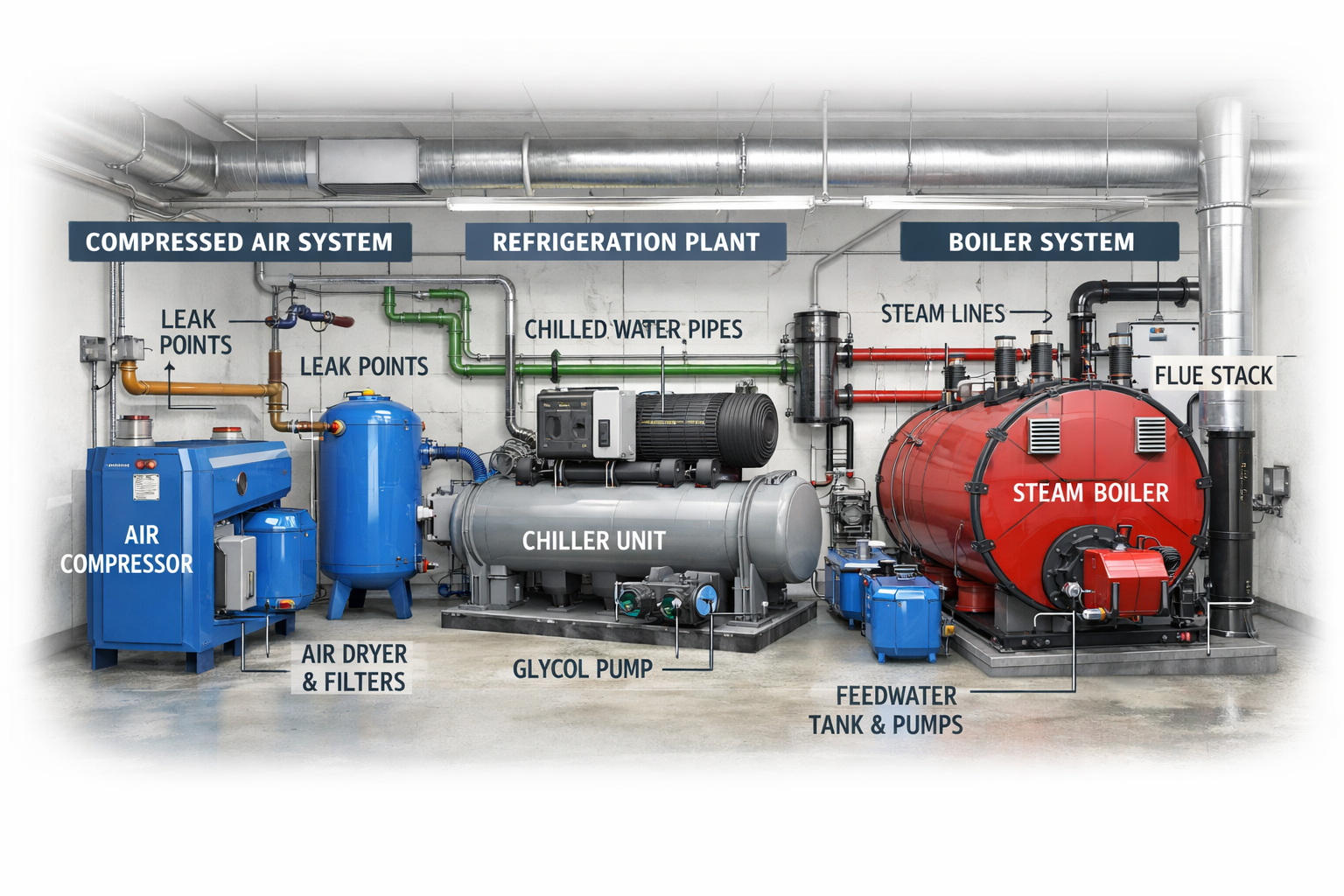
An industrial site is not a standard office building.
You may have:
Process heat loads
Compressed air systems
Refrigeration plant
Steam boilers
High voltage infrastructure
24-hour operations
Production-driven shutdown windows
A capable provider should demonstrate clear experience with similar asset types and operational profiles.
Ask:
Have they audited comparable facilities in manufacturing, logistics, food processing, or heavy industry
Do they understand how production risk affects implementation timing
Can they work around limited access and live plant constraints
If the discussion stays theoretical and does not reference real plant systems, that is a warning sign.
3. Are They Aligned to AS/NZS 3598
Industrial audits in Australia are typically aligned to AS/NZS 3598. The level of audit determines the depth of analysis and confidence in savings.
A credible provider should:
Clearly explain which audit level suits your site
Justify the scope relative to your energy spend and risk profile
Distinguish between high-level screening and investment-grade modelling
If you need clarity on audit levels, see our explanation of AS/NZS 3598 Energy Audits and how each level applies on-site.
Be cautious of providers who promise detailed savings without defining methodology or assumptions.
4. How Strong Is Their Data and Measurement Approach
Industrial energy decisions should be based on evidence, not assumptions.
Evaluate:
What interval data do they request
Whether they conduct temporary metering
How they validate load profiles
Whether they reconcile site data against utility billing
A strong provider will:
Break down consumption by major systems
Identify base load and peak demand drivers
Separate production-related loads from avoidable waste
For example, in a manufacturing facility, compressed air leakage and poor pressure control can materially increase both kWh and kVA demand. If the audit does not quantify this impact, it may not be robust enough for capital planning.
5. Do They Translate Findings Into Commercial Decisions
An audit report should not just list technical upgrades.
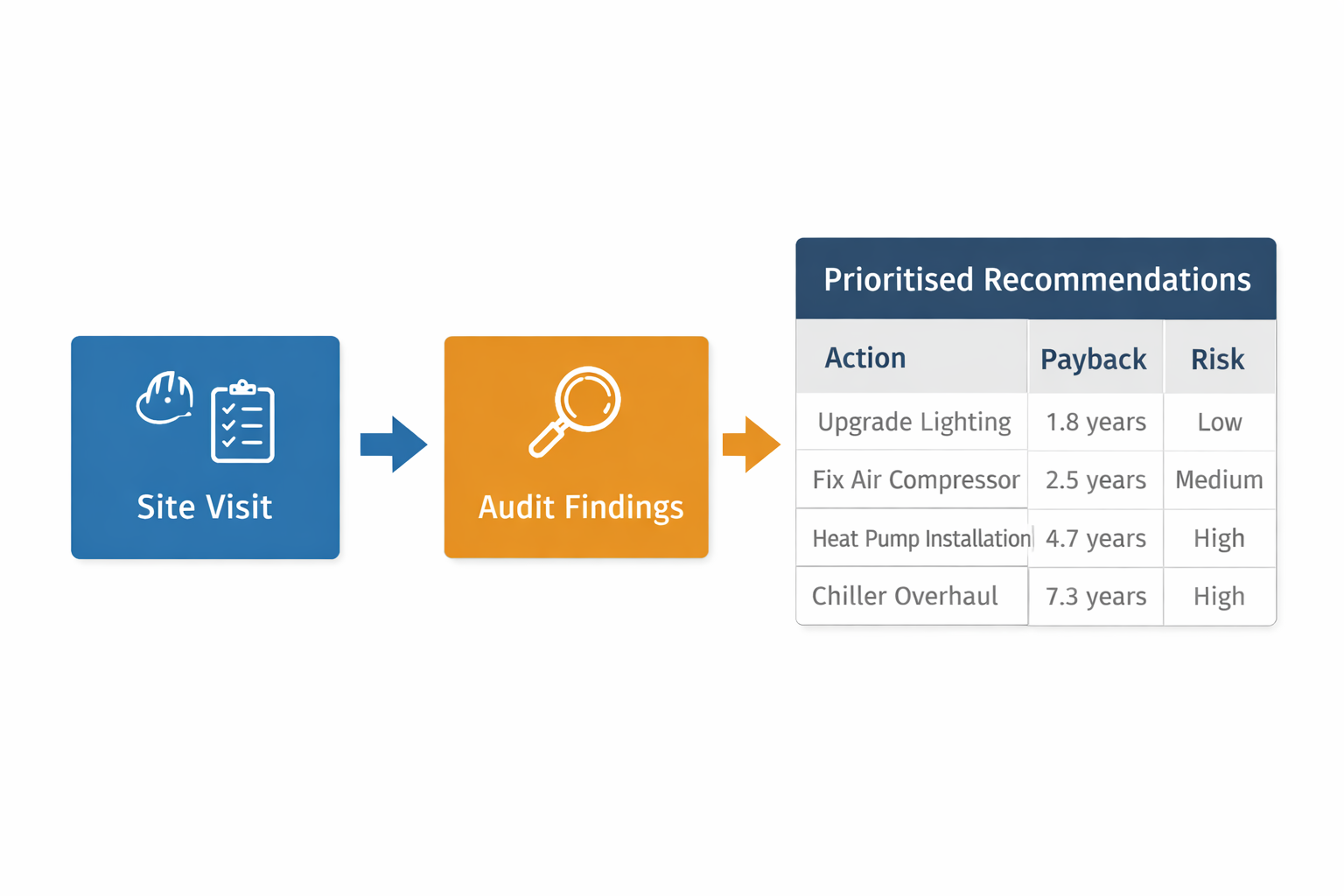
It should clearly show:
Estimated capital cost
Indicative payback period
Impact on operating expenditure
Operational risks
Dependencies such as shutdown windows or switchboard capacity
CFOs and asset managers need decision-ready outputs. Operations managers need implementation clarity.
To see what a structured output looks like, review what you receive from a commercial energy audit and how recommendations are prioritised.
If the provider focuses only on energy savings without linking to risk, cost, and implementation sequencing, the value is limited.
6. Are Savings Estimates Transparent and Conservative
Industrial facilities often face budget pressure. Overstated savings can damage internal credibility.
Check whether the provider:
Explains baseline assumptions
State's confidence levels
Identifies interaction effects between measures
Separates quick wins from capital-intensive upgrades
For example, lighting upgrades may deliver reliable savings with minimal disruption. Process heat electrification may carry a longer payback and require switchboard upgrades. These should not be presented as equivalent opportunities.
Transparent modelling builds trust with finance teams.
7. Do They Consider Reliability and Maintenance Risk
Energy is rarely your only priority.
On industrial sites, you are also managing:
Ageing equipment
Maintenance backlogs
Contractor coordination
Production targets
A strong audit provider will ask:
What assets are nearing the end of life
What failure risks exist
What maintenance windows are realistic
They should integrate energy improvements with asset lifecycle planning. Replacing a failing compressor with a right-sized high-efficiency unit during a planned shutdown is very different from recommending early replacement without operational context.
8. Are They Clear on Scope, Price, and Deliverables
Finally, evaluate commercial clarity.
The provider should clearly define:
Scope of works
Site visit duration
Data requirements
Deliverables
Timeframes
Ambiguity at the proposal stage often translates to gaps in the final report.
You should know exactly what you are purchasing and how it will support operational and capital decisions.
Red Flags to Watch For
Be cautious if you see:
Generic templates reused across industries
No reference to Australian standards
Unrealistic payback claims
Limited discussion of operational constraints
No clear explanation of assumptions
An industrial energy audit should reflect the complexity of your site.
Making the Right Choice
Choosing an industrial energy audit provider is ultimately about risk management.
You are not just buying a report. You are commissioning an analysis that may influence:
Capital expenditure planning
Maintenance prioritisation
Decarbonisation sequencing
Tariff and demand management decisions
A capable provider combines technical rigour with commercial clarity and operational realism.
If you would like to discuss your site, constraints, and whether an industrial energy audit is suitable, contact us for an initial discussion.
Find out about available energy reduction grants and subsidies for your organisation on our Grants page.
