How Energy Audit Findings Turn Into a Decarbonisation Roadmap
Commercial and industrial organisations are under growing pressure to reduce emissions and manage rising energy costs. Many have set high-level Net Zero targets, but the practical pathway from target to implementation is often unclear.
For facility managers and operations teams, the challenge is not ambition. It is time, budget, and the reality of running a site that cannot stop. Ageing equipment, tight maintenance windows, competing capital priorities, and limited contractor availability all make large-scale transition planning difficult.
This is where a commercial energy audit becomes critical. An audit does more than identify inefficiencies. It provides the technical and financial foundation needed to build a realistic decarbonisation roadmap that works within the constraints your site actually faces.
If you are new to how audits work on-site, start with our guide to Commercial and Industrial Energy Audits Australia.
Why energy audits are the starting point for decarbonisation
Many organisations begin decarbonisation planning with high-level goals. Reducing Scope 2 emissions, electrifying a plant, or improving energy efficiency across a portfolio are all legitimate objectives. But without detailed site analysis, these plans often collide with operational reality.
A facility manager dealing with a chiller already on borrowed time, a switchboard with no spare capacity, and a maintenance budget under review cannot execute a decarbonisation plan built on assumptions. They need specific data about their site.
A commercial energy audit provides that data. It gives decision makers a clear picture of:
Where energy is actually being used across the site
Which systems drive the largest emissions and operating costs
Which upgrades are technically feasible, given existing infrastructure
Which projects deliver the strongest financial return within realistic budget constraints
The audit becomes the evidence base that turns a high-level target into a sequenced plan.
From audit findings to upgrade pathways
Energy audit reports typically identify a range of opportunities across different systems. Lighting upgrades, HVAC optimisation, compressed air improvements, and electrification of heating loads are all common findings.
Implementing all recommendations at once is rarely realistic. Capital is limited, operations cannot be disrupted, and contractors may not be available across all trades simultaneously.
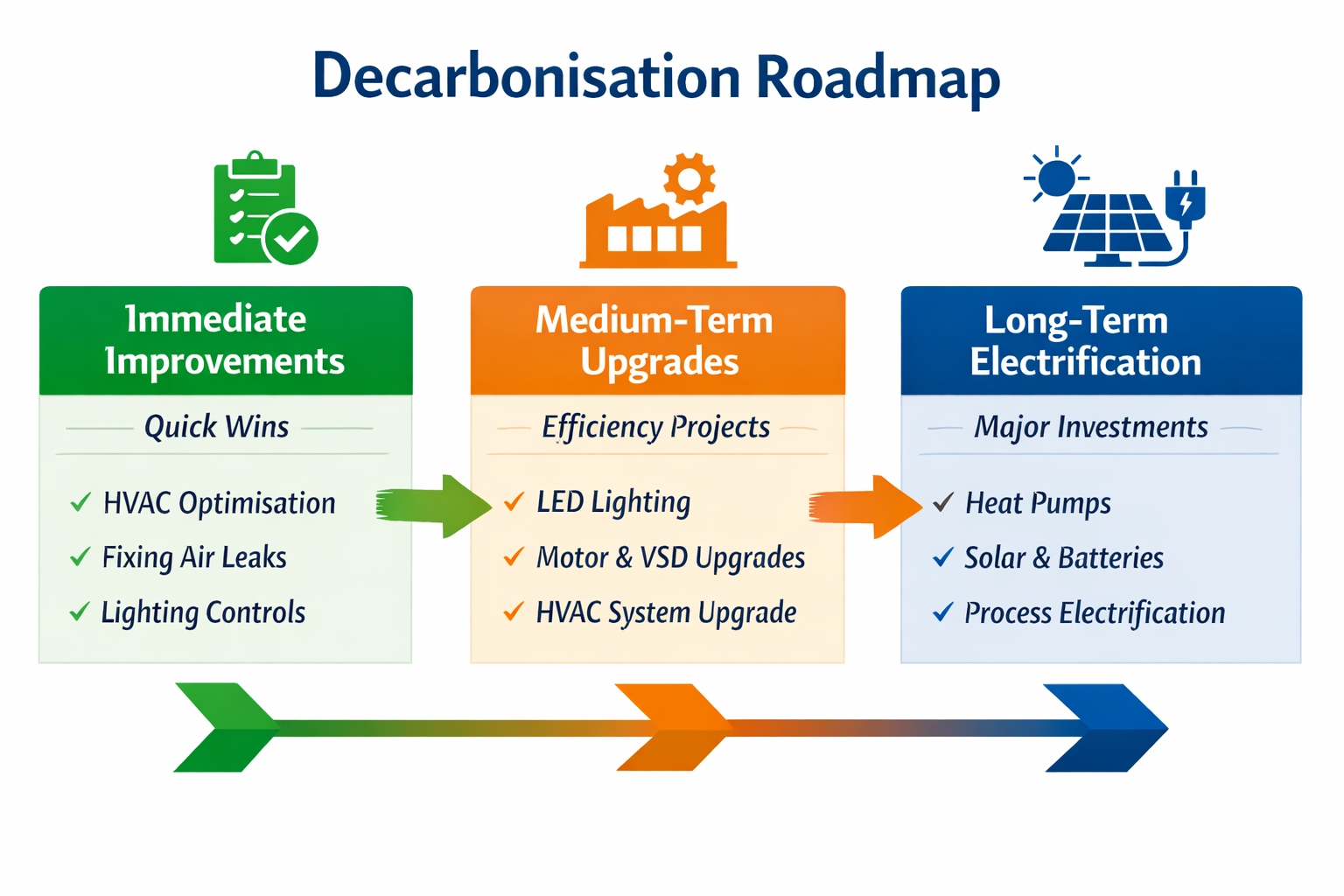
Instead, audit findings are translated into a staged roadmap that balances emissions reduction, operational risk, and financial constraints. Most roadmaps follow three broad stages.
Stage 1. Immediate operational improvements
These actions reduce energy use without major capital investment. They are implemented quickly, often by the existing maintenance team or through minor contractor works, and they help build internal momentum for larger projects.
Typical examples include:
Optimising HVAC schedules and setpoints to match actual occupancy patterns
Fixing compressed air leaks and adjusting system pressure to demand
Improving building management system control strategies
Adjusting lighting schedules and occupancy controls in low-use areas
These improvements often deliver measurable savings within a few months and require minimal coordination during shutdowns.
Stage 2. Medium-term efficiency upgrades
The next stage focuses on equipment upgrades that reduce energy demand and operating costs. These projects require capital investment and are most effectively aligned with existing maintenance cycles or planned asset replacements.
A facility manager who knows a chiller is approaching the end of its life can use audit data to justify replacing it with a high-efficiency unit rather than a like-for-like swap. This avoids a separate capital request later and reduces the disruption of two separate work packages.
Typical projects include:
LED lighting upgrades in warehouses, production areas, and car parks
Variable speed drives on pumps, fans, and compressors
High-efficiency motor replacements
HVAC system upgrades and improved zone control
Stage 3. Long-term electrification and system transition
The final stage addresses larger decarbonisation changes. These projects involve higher capital investment, more complex planning, and often require extended shutdown windows that need to be scheduled months in advance.
Common examples include:
Replacing gas heating systems with heat pumps
Electrifying process heat where technically feasible
Integrating onsite solar and battery storage
Upgrading electrical infrastructure to support electrification loads
Electrical capacity is often the constraint that gets overlooked until a project is already in motion. Switchboard capacity, transformer limits, and grid connection conditions must be assessed before electrification projects proceed. The audit surfaces these constraints early so they can be factored into planning rather than discovered during delivery.
Operational realities that shape the roadmap
Every site has constraints that influence how quickly upgrades can be implemented. A well-structured decarbonisation roadmap accounts for these from the outset rather than treating them as obstacles to work around later.
Budget pressure is the most common constraint. Large capital upgrades typically require board approval and multi-year planning. The audit helps by providing the financial modelling needed to build that business case, with indicative payback periods, net present value estimates, and annual operating cost savings for each opportunity.
Ageing equipment is another practical reality. Facilities running a 20-year-old plant are often managing reliability risk alongside energy performance. The audit helps prioritise replacements that address both, so a failing compressor is replaced with a high-efficiency unit rather than being repaired again.
Operational continuity is a real constraint that can be overlooked in high-level decarbonisation plans. Facilities that operate continuously, such as food processing, healthcare, and manufacturing sites, must schedule upgrades within tight maintenance windows. Contractor coordination across multiple trades adds further complexity. The audit identifies which upgrades can be staged in short shutdowns and which require extended outages, allowing realistic scheduling to be built into the plan.
How audits help prioritise projects
Not every opportunity identified in an audit will be implemented immediately. A key function of the audit is to help decision makers prioritise projects across competing criteria.
Audit reports typically include an opportunity register that ranks projects based on:
Energy and emissions reduction potential
Capital cost and payback period
Operational risk and complexity of delivery
Interaction with existing equipment and maintenance schedules
For example, an LED lighting upgrade in a logistics facility may deliver a three-year payback with minimal operational disruption and straightforward contractor coordination. A full HVAC replacement may deliver larger savings but require extended downtime, specialist contractors, and significant capital investment across multiple financial years.
Understanding these trade-offs allows organisations to plan upgrades over several years rather than attempting an unrealistic short-term transition.
Turning audit insights into a long-term strategy
Decarbonisation is rarely achieved through a single project. It requires coordinated upgrades delivered over time, aligned to maintenance cycles, capital planning cycles, and operational windows.
Energy audits provide the structured data needed to support this process. They help organisations understand their energy systems, identify realistic upgrade pathways, and prioritise investments that balance cost, risk, and emissions reduction.
Many organisations use audit findings to create a multi-year upgrade pipeline. Projects are then delivered as equipment reaches the end of life or when operational shutdown windows allow installation. This staged approach reduces disruption while steadily improving site efficiency and emissions performance.
If you want to understand how audit data becomes actionable operational insight, read our article on Turning Energy Audit Data Into Actionable Insights. You can also explore how audits help prioritise emissions reduction investments in Using Energy Audits to Prioritise Decarbonisation Upgrades.
Discuss your site and decarbonisation pathway
Every facility has different operational constraints, equipment lifecycles, and energy systems. A well-structured commercial energy audit helps translate these realities into a practical decarbonisation roadmap that works within the limits of your site and budget.
If you want to understand how an audit could support planning for your site, contact us to request a commercial energy audit or discuss your facility with the team.
Find out about available energy saving grants and subsidies for your organisation on our Grants page.
