How Energy Audits Support Commercial Building Disclosure Compliance
Commercial Building Disclosure (CBD) rules affect many large office buildings in Australia. Owners must disclose energy performance before selling or leasing office space above certain size thresholds.
For many building owners and asset managers, the CBD process raises practical questions.
What information is required? How accurate does the energy rating need to be? What to do if the building performs poorly.
Energy audits often play a critical supporting role in this process. They help building owners understand performance, identify opportunities for improvement, and reduce compliance risk.
Understanding the Commercial Building Disclosure Scheme
The Commercial Building Disclosure scheme applies primarily to office buildings larger than 1,000 square metres when they are sold or leased.
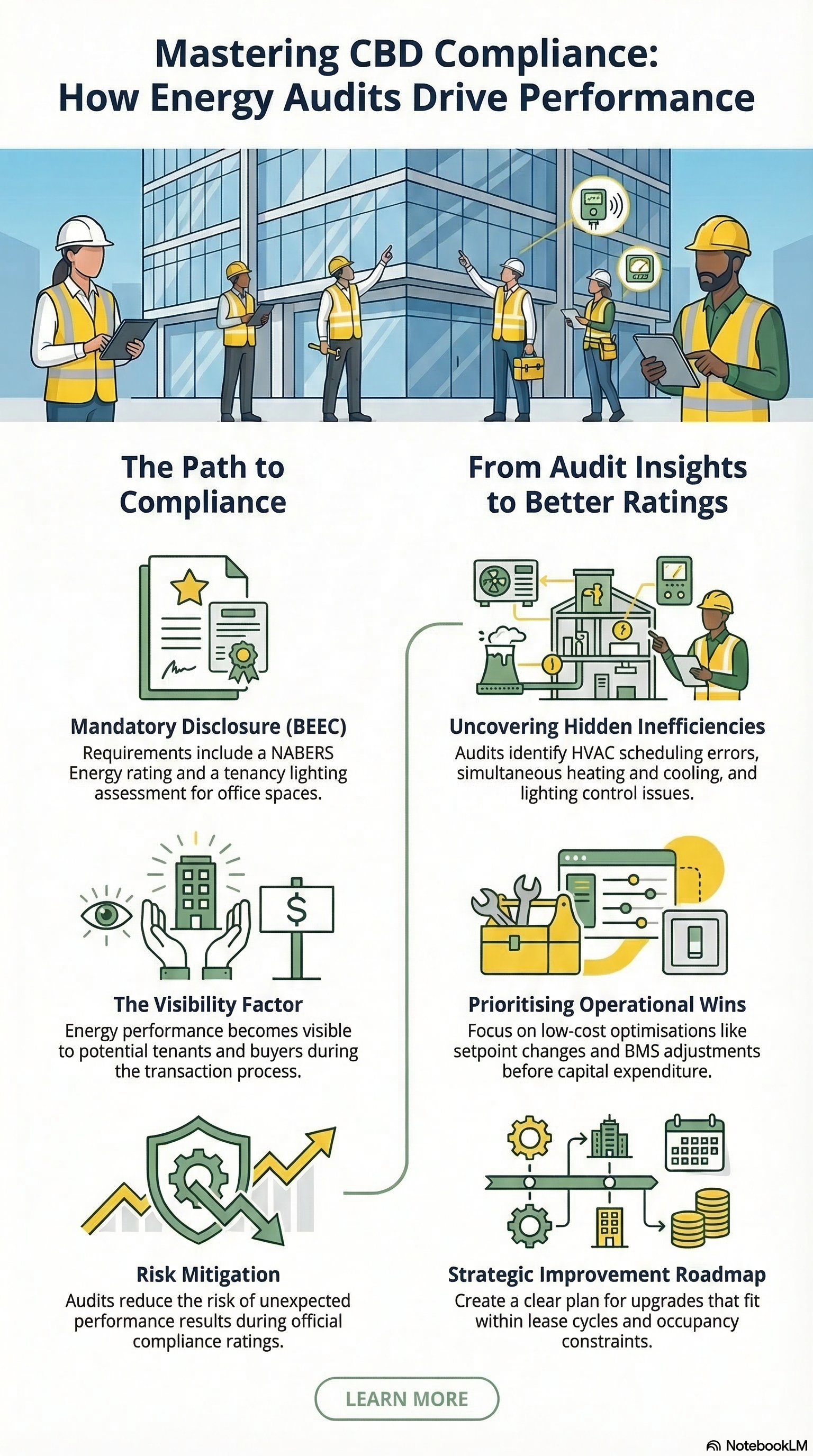
In most cases, the disclosure must include a Building Energy Efficiency Certificate (BEEC). This certificate includes:
A NABERS Energy rating for the base building or whole building
A tenancy lighting assessment for the office space
General guidance on improving energy efficiency
For many owners, the challenge is not the paperwork. The challenge is the building itself.
Older plant, inefficient HVAC systems, or poorly controlled lighting can all result in a low NABERS rating. That rating becomes visible to potential tenants and buyers.
Why Building Owners Use Energy Audits Before Disclosure
An energy audit provides a structured assessment of how a building actually consumes energy. It identifies the systems responsible for major loads and the operational factors affecting performance.
This insight helps owners prepare for disclosure in several ways.
First, it clarifies where energy is being used.
Common findings in office buildings include:
HVAC systems running outside occupied hours
Simultaneous heating and cooling due to control issues
Ageing chillers or boilers operating inefficiently
Lighting systems without zoning or occupancy control
Second, it identifies improvements that can lift the NABERS rating. Some of these improvements are operational changes. Others require targeted upgrades.
Third, it reduces the risk of unexpected performance results upon completion of a rating. For owners planning a lease or asset transaction, that certainty matters.
If you want to understand the broader role of energy audits in commercial buildings, see Commercial and Industrial Energy Audits Australia.
What Energy Audits Reveal in Office Buildings
Energy audits frequently uncover performance issues that are not obvious during normal building operations.
Typical audit findings include:
HVAC scheduling problems
Air-handling units and chilled-water systems often run far longer than required. In some buildings, the plant operates overnight or through weekends due to outdated control settings.
Inefficient plant operation
Older chillers, cooling towers, or boilers may still function reliably but operate at lower efficiency than modern equipment.
Control and BMS limitations
Buildings sometimes have building management systems that are only partially used. Control sequences may be simplified or disabled over time.
Lighting inefficiencies
Tenancy lighting upgrades are inconsistent across floors. Some areas still use older fittings or lack occupancy sensors.
Operational constraint reality
Many office buildings operate with long lease cycles and multiple tenants. Access to plant rooms or tenancy spaces may be limited. Upgrade projects must often be scheduled around occupancy and business continuity. Energy audits help owners understand these constraints and prioritise practical improvements.
How Energy Audits Support NABERS Rating Improvements
A NABERS rating reflects the actual energy performance of a building. Improving that rating requires understanding how the building performs in practice.
Energy audits provide the technical and operational insight required to improve performance.
Examples of improvements identified during audits include:
HVAC optimisation through scheduling changes
Improved temperature setpoints and control sequences
Chiller or cooling tower optimisation
LED lighting upgrades in base building areas
Variable speed drives on pumps and fans
In many cases, the first improvements involve operational changes rather than major capital expenditure. These improvements can reduce energy use while also supporting stronger NABERS ratings.
If you want to understand what information is typically delivered in an audit report, see What You Receive From a Commercial Energy Audit.
Preparing Buildings for Disclosure
For property owners managing portfolios, the CBD scheme introduces a reputational and commercial factor. Energy performance becomes visible in leasing and sales processes.
Buildings with stronger NABERS ratings may attract greater tenant interest and support leasing outcomes. Buildings with poor ratings may require explanation or improvement planning.
Energy audits help owners prepare for this situation by:
Identifying efficiency opportunities before disclosure
Providing a roadmap for operational improvement
Highlighting systems that affect energy performance most strongly
This allows building owners to make informed decisions about timing, upgrades, and investment.
How we Support CBD Preparation
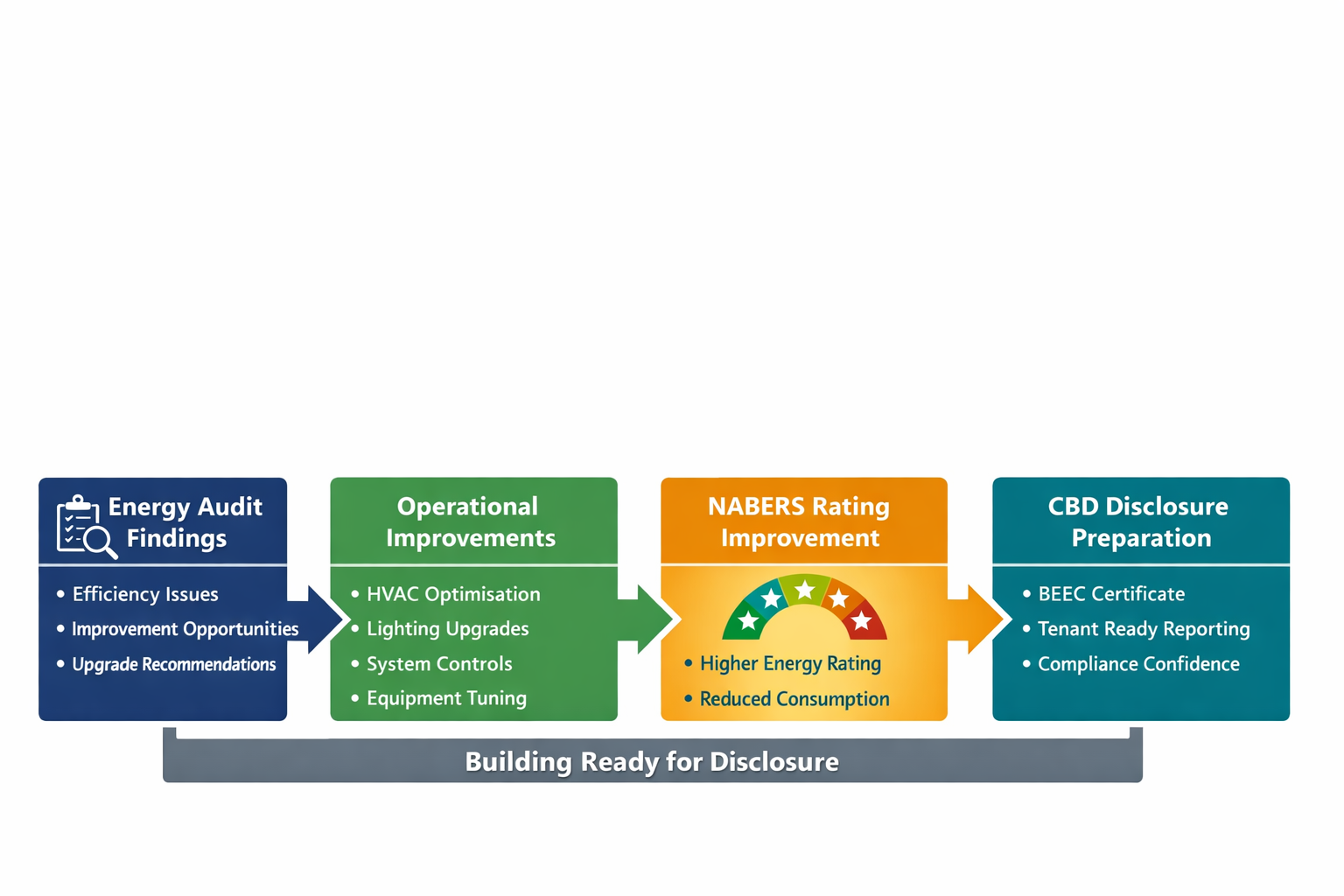
Energy audits do not replace NABERS assessments or CBD certificates. However, they provide the operational insights needed to improve building performance before disclosure.
For many office buildings, the most valuable outcome of an audit is clarity.
Which systems drive energy use? Which improvements are realistic within operational constraints? Which changes can improve energy performance before the next rating?
If your building may be subject to Commercial Building Disclosure requirements, an energy audit can help clarify your starting point and improvement opportunities.
If you would like to discuss your building and the practical constraints on site, contact us for an initial discussion about a commercial energy audit.
Find out about available energy saving grants and subsidies for your organisation on our Grants page.