Commercial Building Disclosure and Energy Audits. What Building Owners Need to Know
In Australia, the Commercial Building Disclosure scheme affects many office building transactions. When a building owner sells, leases, or subleases certain office spaces, energy performance information must be disclosed to the market.
For facility managers and property teams, this requirement rarely arrives at a convenient time. It often lands during a lease-renewal campaign, an asset-sale process, or a capital-planning cycle, when budgets are tight, plant rooms are already under pressure, and resources are stretched across competing priorities.
The practical question is straightforward. How do you actually improve building performance once the rating is known?
This is where energy audits become important. They help translate compliance requirements into operational and financial decisions.
This article explains how the Commercial Building Disclosure scheme works and how energy audits support building owners who want to improve performance, reduce costs, and plan upgrades.
Commercial Building Disclosure. What the regulation requires
The Commercial Building Disclosure program requires building owners to disclose a current NABERS Energy rating when selling or leasing large office spaces.
The requirement generally applies when:
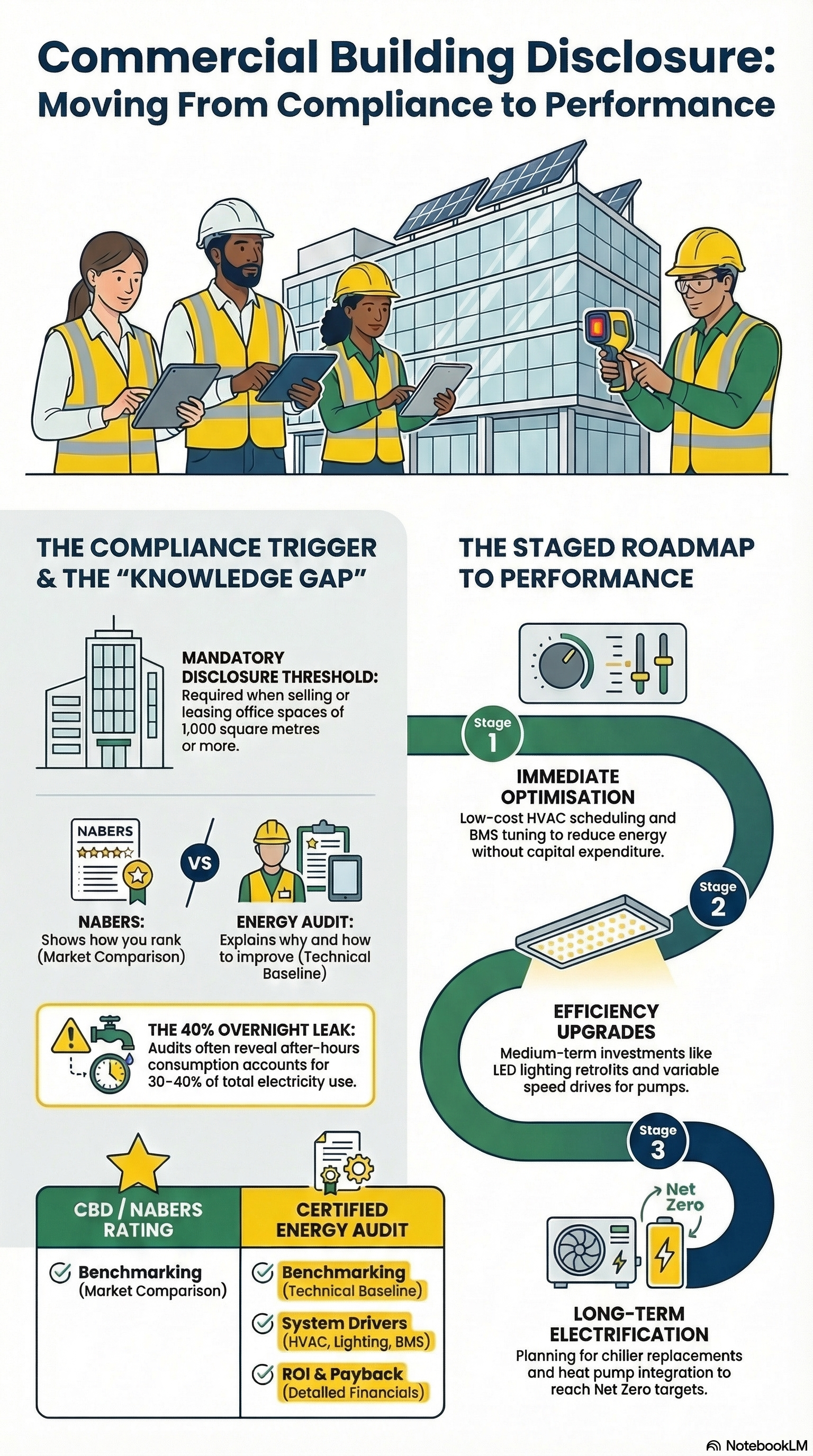
Office space of 1,000 square metres or more is sold or leased
A building is marketed for sale or lease
Advertising materials are published for the property
The disclosure typically includes:
A NABERS Energy rating
A tenancy lighting assessment
A Building Energy Efficiency Certificate
From a compliance perspective, this is straightforward. However, the rating itself only shows the outcome. It does not explain why the building performs the way it does.
This is where a deeper technical assessment becomes useful.
How energy audits support CBD compliance
An energy audit examines the systems and operational patterns behind a building's energy use.
Instead of simply reporting a rating, an audit investigates:
HVAC system performance
Base building electricity consumption
Control strategies within the BMS
Lighting system efficiency
Operational schedules and occupancy patterns
This allows building owners to understand what is driving the energy intensity reflected in a NABERS rating.
For facility managers already managing maintenance backlogs and ageing plant, the audit process is designed to work around building operations. It does not require extended shutdowns or significant internal resourcing. The site visit is typically completed within a day for a single-tenancy building, with data collection done in parallel against the building management system. For more on how the process runs from start to finish, see our guide to commercial and industrial energy audits in Australia, which covers what each stage entails and how long each stage takes.
Typical findings in office building audits
Across Australian office buildings, energy audits tend to uncover similar patterns. Many sites operate with ageing equipment and control strategies that have not been updated for years. For facility managers, these issues are often known but deprioritised because the plant is still running and the immediate workload is focused on reactive maintenance and tenant requests.
Common findings include:
HVAC optimisation gaps
Chillers and air handling systems often run longer than necessary. Poor scheduling or outdated control logic can drive significant base load consumption. In many buildings, this has not been reviewed since the BMS was first commissioned.
Lighting inefficiencies
Many buildings have partially upgraded lighting systems. Legacy fittings may still operate in plant rooms, corridors, or car parks. These are often the last areas addressed because they are not tenant-facing, but they consistently contribute to the base load.
Simultaneous heating and cooling
This occurs when different zones compete for control due to control logic or sensor issues. It is common in older building management systems and is often masked by tenant comfort complaints that appear unrelated.
Excess overnight loads
Interval meter data often reveals significant energy use outside business hours. In some buildings, after-hours consumption accounts for 30 to 40 per cent of total electricity use, driven by a plant that was never set to a proper night setback mode.
These patterns often explain why a building's energy rating is lower than expected.
What a CBD rating does not show
A NABERS rating provides a benchmark comparison across buildings. It tells the market how a building performs relative to others.
However, it does not show:
Which systems drive the majority of energy use
Where operational inefficiencies exist
Whether equipment upgrades are viable
The cost and payback of improvement measures
An energy audit fills this gap by identifying the operational drivers behind the rating.
This insight becomes valuable when asset owners plan upgrades or capital works. For facility managers, it also provides the documented evidence needed to support a business case for capital expenditure, which can otherwise be difficult to secure without clear data on potential savings.
From compliance to performance improvement
Many building owners initially engage with CBD requirements purely for compliance. However, the information generated by the process can serve as a starting point for broader energy performance improvements.
An energy audit typically produces a structured recommendation register. A common staging approach looks like this:
Immediate operational improvements
HVAC scheduling optimisation
BMS control tuning
After-hours load reduction
Medium-term efficiency upgrades
Lighting retrofits in common areas
Variable speed drives for pumps and fans
HVAC control upgrades
Long-term electrification and plant replacement
Chiller replacement planning
Heat pump integration
Electrical capacity assessment
This staged approach helps asset owners balance operational disruption, capital budgets, and tenant constraints. For facility managers, the immediate tier is particularly useful. Control changes and scheduling adjustments can often be implemented without capital expenditure, contractor procurement, or extended access windows.
Operational realities in commercial buildings
Facility managers dealing with CBD compliance often face constraints that make it difficult to act on energy data, even when the intent is there.
Common pressures include:
Limited shutdown windows for HVAC work, particularly in multi-tenancy buildings with strict access requirements
Tenant comfort obligations during business hours that restrict when the plant can be adjusted
Budget approval cycles that require documented savings projections before capital is released
An ageing plant that still functions but operates inefficiently, making it hard to justify replacement without a clear financial analysis
Contractor coordination challenges when multiple trades are needed across a single scope of work
A well-conducted energy audit accounts for these realities. Recommendations are staged to reflect what is operationally feasible, not just technically optimal. For most facility managers, improvements start with control changes and scheduling adjustments, which reduce energy consumption without major disruption or capital outlay.
How energy audits support NABERS improvement plans
Energy audits are often used to inform NABERS improvement strategies. The audit identifies operational and equipment changes that would improve building performance prior to the next rating assessment.
Examples include:
Adjusting plant scheduling
Optimising chilled water temperatures
Improving zone control logic
Reducing unnecessary base load consumption
These improvements can lift building performance without immediate capital expenditure. In some cases, staged upgrades identified in an audit form the basis of a longer-term decarbonisation plan, aligning energy efficiency improvements with future electrification and asset replacement.
Why this matters for asset value
Energy performance increasingly affects commercial property value. Tenants, investors, and asset managers all assess energy performance as part of leasing and acquisition decisions.
Buildings with poor energy performance may face:
Reduced tenant demand
Higher operating costs
Increased capital expenditure pressure
Lower NABERS ratings compared with competitors
An energy audit provides a structured path to improve performance and manage these risks. Rather than reacting to disclosure requirements, building owners gain a clear plan for operational and capital improvements.
For asset managers and CFOs evaluating the financial case for energy upgrades, our article on energy audits for CFOs explains how audit findings translate into ROI, payback periods, and capital planning decisions.
Next step for building owners
If your building is approaching a sale, lease campaign, or NABERS rating assessment, it may be worth understanding what is driving your current energy performance.
An energy audit can identify operational improvements, efficiency upgrades, and longer-term plant replacement opportunities. For facility managers and property teams managing competing priorities, the process is designed to fit around building operations with minimal disruption.
Contact us for an initial discussion about your site, constraints, and objectives.
Find out about available energy reduction grants and subsidies for your organisation on our Grants page.
