How Energy Audits Support Commercial Building Disclosure Compliance
If you own or manage an office building in Australia, Commercial Building Disclosure (CBD) is a compliance obligation you cannot ignore at the point of sale or lease.
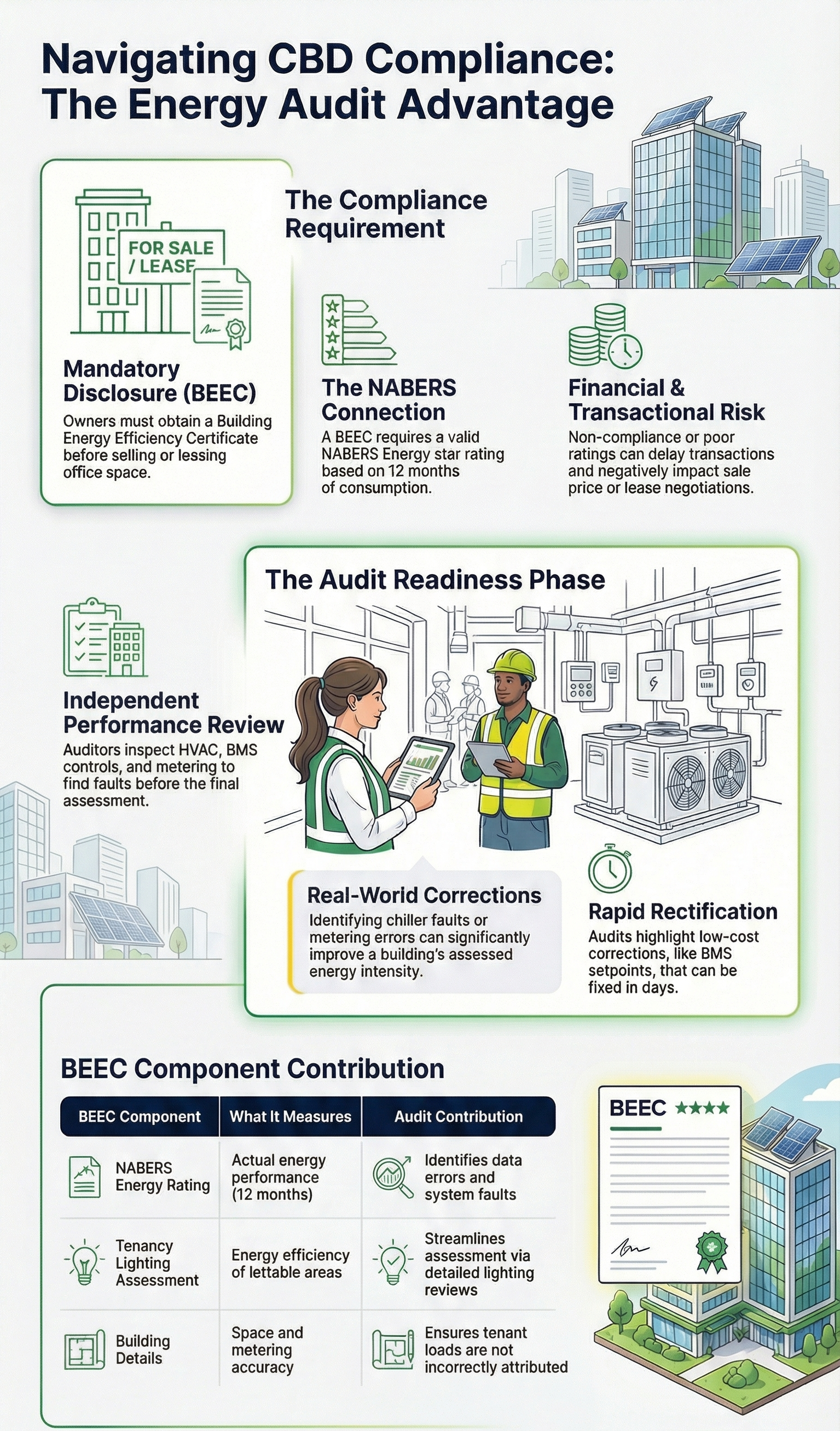
The CBD program is a federal government scheme. It requires owners of office space at or above 1,000 square metres to obtain and disclose a Building Energy Efficiency Certificate (BEEC) before selling or leasing that space. A BEEC includes a current NABERS Energy star rating for the building and a Tenancy Lighting Assessment. It must be obtained before a transaction is completed, and it has a defined validity period.
Failing to comply carries financial penalties. More practically, it can delay or disrupt a transaction if you leave it too late.
A commercial energy audit is one of the most useful tools available to prepare your building for this process.
What the CBD Program Actually Requires
To obtain a BEEC, your building needs a valid NABERS Energy rating. That rating is based on measured energy consumption data, typically covering 12 months. It reflects actual performance, not design intent or assumed efficiency.
If your building has not been rated recently, or if your rating has lapsed, you need to go through the rating process again before you can disclose. That takes time. It also requires that your energy data be in order, your metering be reliable, and your base building systems operate as expected.
This is where many building owners run into problems. They reach a transaction deadline and discover their building is not ready to be rated, or that the rating it receives is lower than expected. Both outcomes create risk.
What an Energy Audit Adds to This Process
An energy audit does not replace the NABERS rating process. What it does is give you a detailed, independent assessment of how your building is actually performing before that rating is finalised.
In practical terms, that means an auditor walks your plant room, reviews your HVAC controls, inspects your metering configuration, and assesses your lighting and other major loads. They compare measured consumption against expected performance for a building of your type and size.
Indicative Example: A 4,500sqm commercial office building in a CBD precinct commissioned an audit ahead of a planned lease transaction. The audit identified a chiller control fault and a split metering arrangement that was incorrectly attributing tenant load to the base building account. Correcting these issues before the NABERS rating was conducted improved the assessed base-building energy intensity and supported a better star-rating outcome.
The audit also produces findings you can act on. If your HVAC scheduling is misaligned, your BMS is running outdated setpoints, or your lighting has not been upgraded, an audit identifies these issues and provides a prioritised list of low-cost corrections. Some of those corrections take days, not months. They can meaningfully improve your building's measured performance before the NABERS assessor runs the numbers.
This is not about gaming the system. It is about making sure the rating reflects your building's genuine operating capability, not a temporary fault or a data error.
The Tenancy Lighting Assessment
The BEEC also requires a Tenancy Lighting Assessment. This assesses the energy efficiency of lighting in any lettable area covered by the disclosure. It produces a star rating for tenancy lighting, separately from the base-building NABERS rating.
An energy audit often covers the same ground. If your auditor has already assessed your tenancy lighting in detail, that work informs and, in some cases, streamlines the formal assessment process.
This is worth raising with your auditor at the scoping stage. Ask whether their assessment methodology aligns with the requirements of the Tenancy Lighting Assessment under the CBD program.
Timing Is the Practical Issue
The most common mistake building owners make is treating CBD compliance as a transaction step rather than a property management discipline.
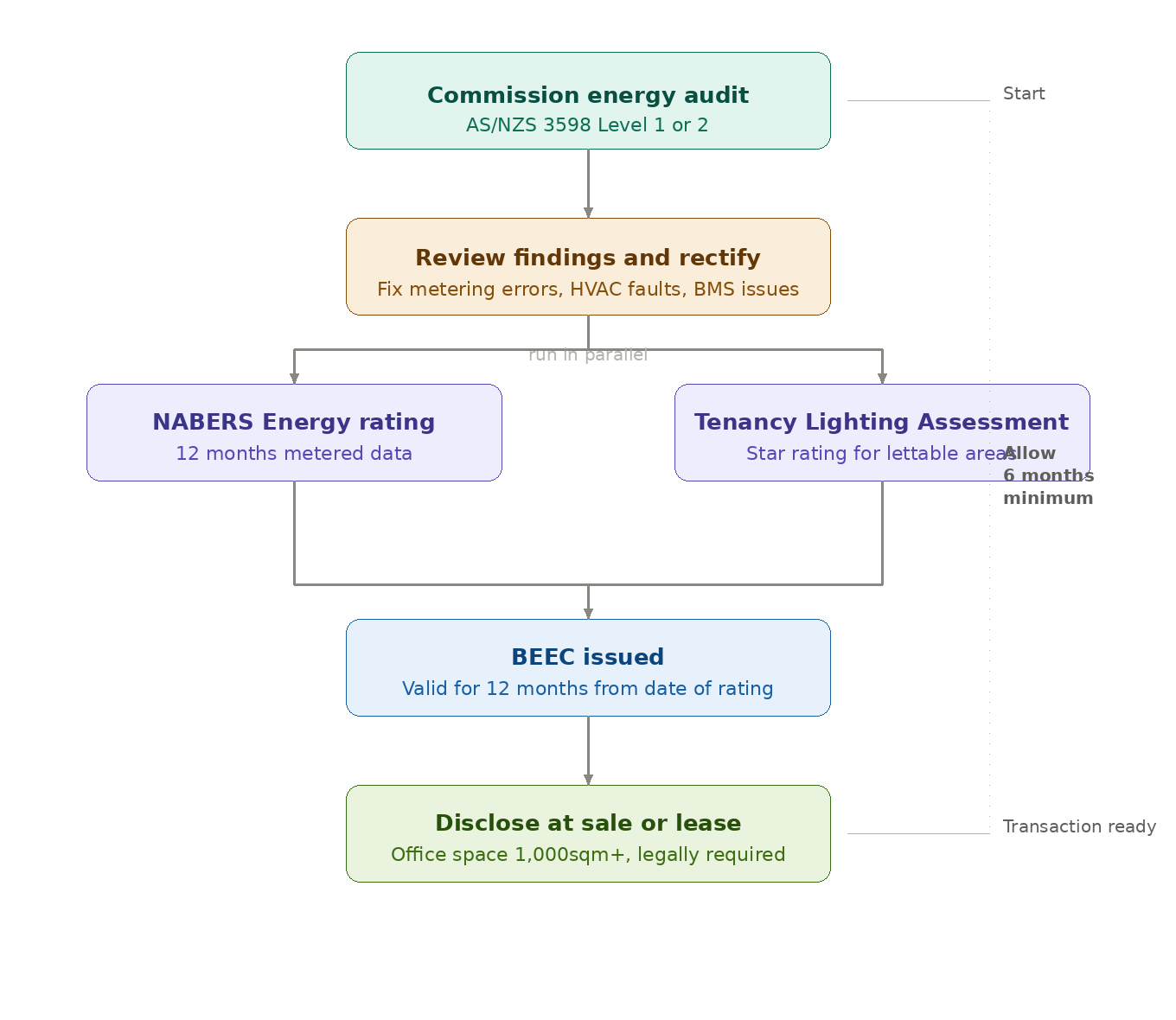
A NABERS rating and a full energy audit both take time. Metering data needs to be collected, verified, and submitted. Site access needs to be coordinated with tenants and contractors. If defects are identified, rectification takes additional time.
If you begin this process six months before a planned transaction, you have time to address issues and achieve a strong rating. If you begin two weeks before the exchange, you do not.
Building owners who manage a portfolio of office assets typically treat CBD readiness as part of their ongoing compliance calendar. They know their BEEC expiry dates, they track their NABERS ratings across the portfolio, and they commission audits proactively rather than reactively.
For guidance on how audits fit into broader portfolio management, see How Energy Audits Support NABERS Improvement Plans and our overview of Commercial and Industrial Energy Audits Australia.
What to Do if Your Building Has Not Been Audited Recently
If your last energy audit is more than two years old, or if you have not had one at all, start there. The audit provides a current picture of how your building is performing, what is driving consumption, and what needs to be corrected before you proceed with a formal NABERS rating.
The audit report also gives you documentation. If a prospective purchaser or tenant asks questions about the building's energy performance or planned upgrades, you have a credible, independent document to draw from. That matters in due diligence conversations.
You can read more about what a commercial energy audit covers in our companion article, Commercial Building Disclosure and Energy Audits: What Building Owners Need to Know.
The Commercial Risk Is Real
Non-disclosure or delayed disclosure under the CBD program is a compliance risk. A weak NABERS rating disclosed at the wrong moment can affect lease negotiations, sale price, or buyer confidence. These are not theoretical risks. They occur when buildings are not managed with disclosure obligations in mind.
An energy audit is the most practical first step toward managing that risk. It gives you facts, not assumptions, and time to act before a transaction is in motion.
Ready to prepare your building for CBD compliance?
To discuss whether your building is ready for Commercial Building Disclosure, contact us.
Find out about available energy reduction grants and subsidies for your organisation on our Grants page.
