Energy Audits in Asset Due Diligence. What Buyers Often Miss
When you acquire a commercial or industrial asset in Australia, energy risk rarely sits at the top of the checklist.
Leases. Structural condition. Compliance. Revenue. Energy is often treated as a line item in operating expenses.
That is a mistake.
Across manufacturing sites, large commercial buildings, logistics facilities and healthcare assets, energy performance directly affects:
Net operating income
Capex exposure
Compliance risk
Decarbonisation obligations
Future tenant competitiveness
An energy audit conducted during asset due diligence can change how you view the asset before you commit capital.
Where energy risk hides during acquisition
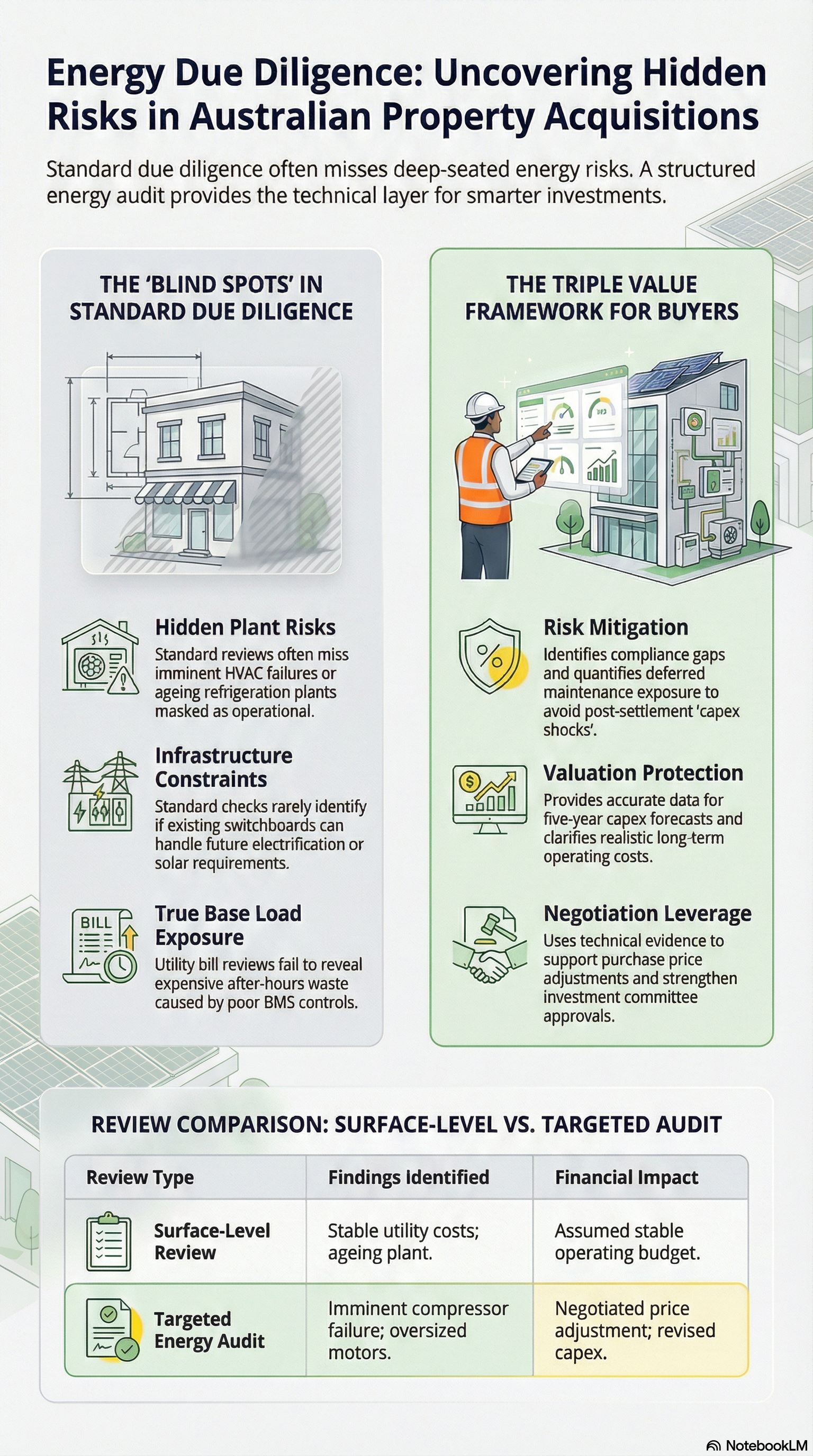
In most transactions, buyers review 12 months of utility bills, basic NABERS ratings if available, equipment age schedules, and maintenance reports.
What this rarely shows:
True after-hours base load
Control failures in HVAC and BMS
Inefficient process loads
Demand charge exposure
Electrification constraints
Embedded gas dependency
Deferred plant upgrades are masked as operational
A structured commercial and industrial energy audit in Australia provides the technical layer behind the financials.
Energy cost is not the only issue
Asset buyers often focus on current annual energy spend. The more important questions are:
Is this cost artificially low due to an underperforming plant that will soon fail?
Is a major HVAC replacement imminent?
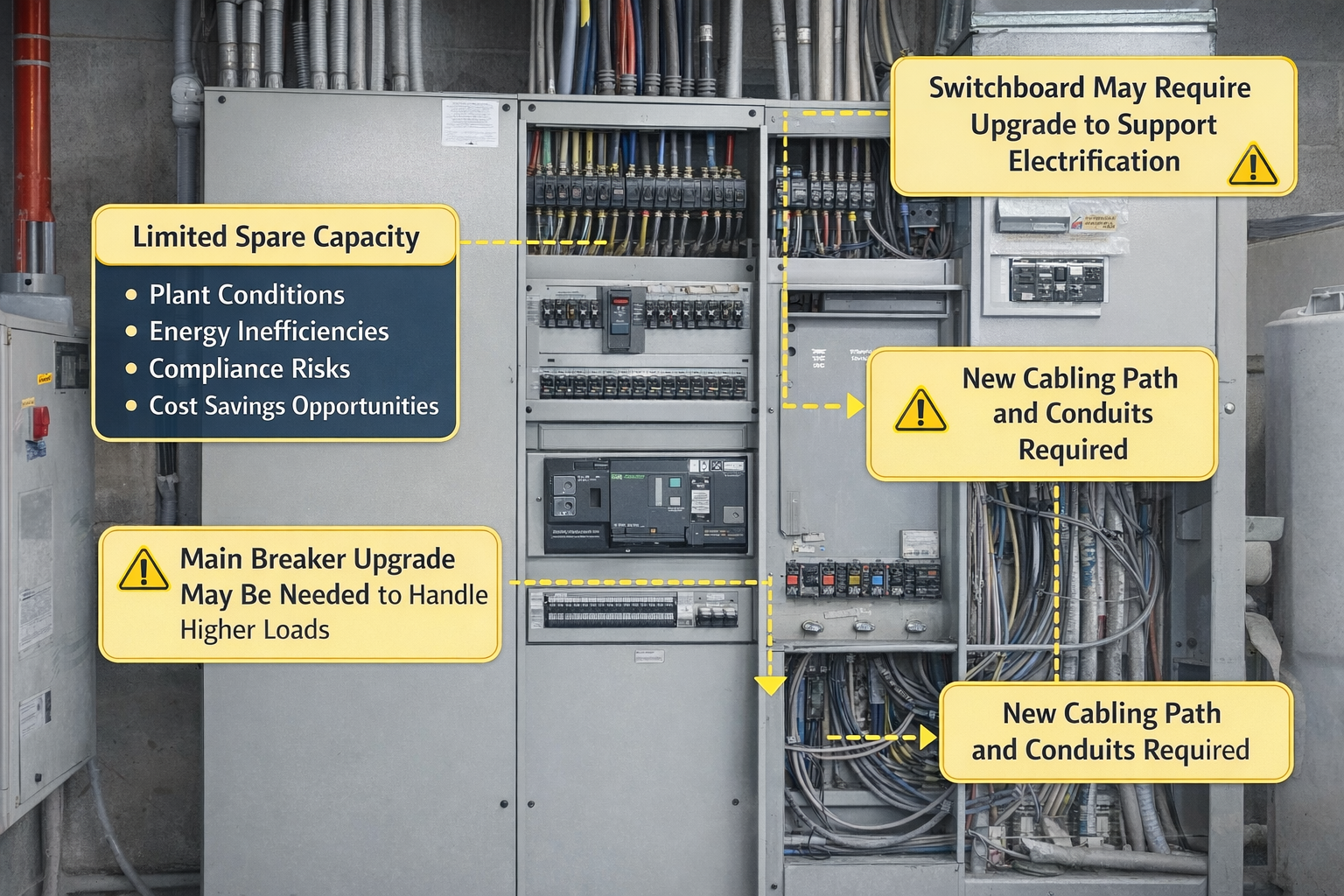
Is the electrical infrastructure sufficient for electrification?
Will future carbon reporting expose liabilities?
Are there easy efficiency gains that justify a purchase price adjustment?
Energy audits in due diligence answer these questions with evidence, not assumptions.
Indicative example. Industrial acquisition
In a recent indicative example of a mid-sized food manufacturing site:
Annual electricity and gas cost. Approximately $1.2 million
Ageing ammonia refrigeration plant
Significant after-hours base load from compressed air and cold storage
No recent controls optimisation
Surface-level review suggested stable costs. A targeted energy audit during due diligence identified:
Imminent compressor replacement risk
Oversized motors operating at low load
Demand charge exposure from poor staging
Heat recovery opportunity, reducing gas use
The audit modelled staged upgrades over five years. Outcome for the buyer:
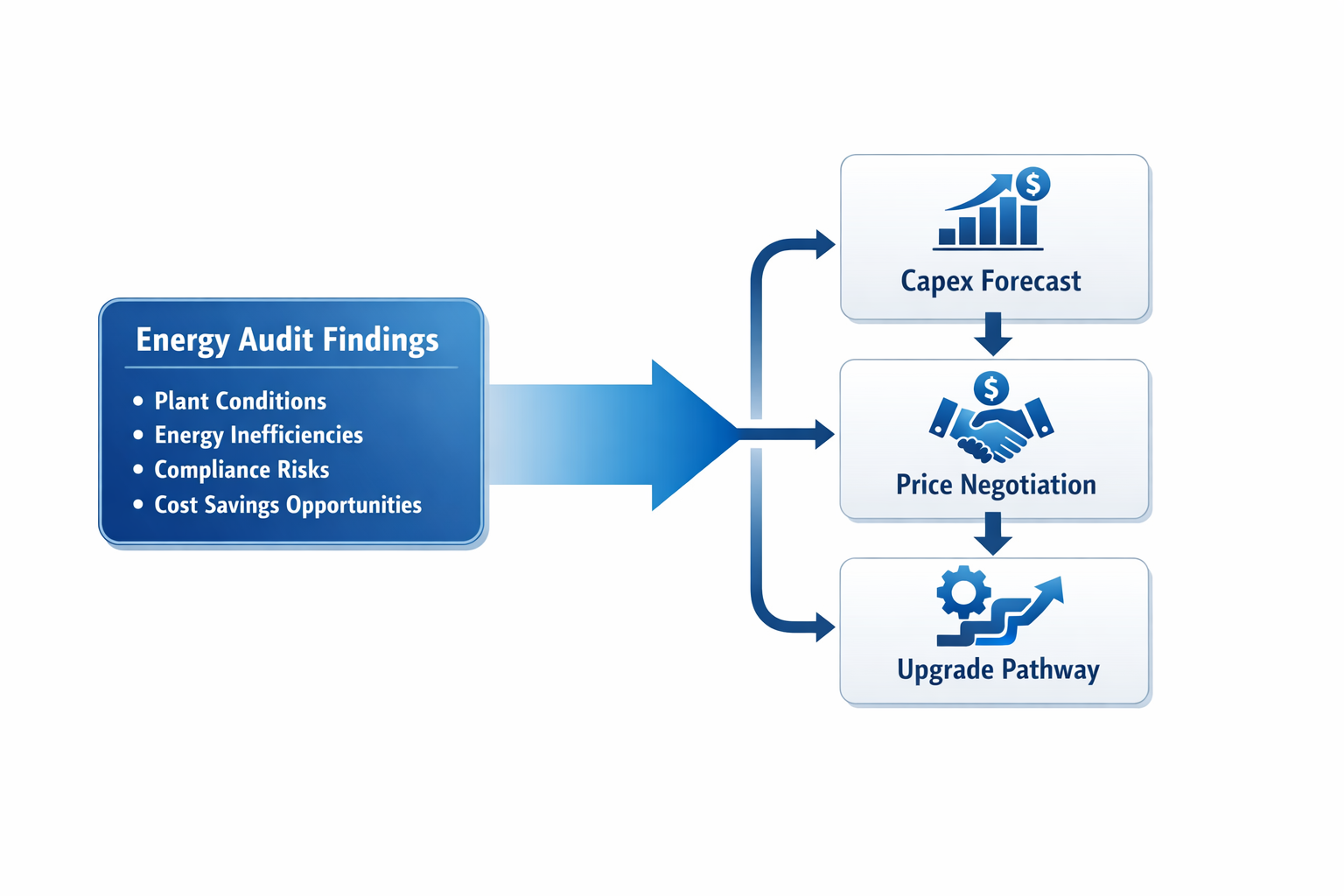
Revised capex forecast
Negotiated price adjustment reflecting plant risk
Immediate operational improvements post-settlement
Clear decarbonisation pathway
Without the audit, the risk of plant condition would have appeared as a surprise within 24 months.
Indicative example. Commercial office building
In a large occupied commercial building with a 3.5 Star NABERS rating, stable tenants, and rising electricity costs, standard due diligence focused on tenancy and leases. Energy audit findings included:
Poor after-hours controls
Simultaneous heating and cooling
Oversized base building plant
Tenant lighting inefficiencies
The audit outlined low-disruption control changes, targeted capital upgrades, and an expected uplift in NABERS rating. This matters for asset value. Energy performance affects tenant attraction, compliance and long-term operating costs.
Energy audits support NABERS improvement plans. They do not replace formal ratings, but they inform how improvements are staged.
Portfolio acquisitions. Why consistency matters
For private equity and infrastructure funds acquiring multiple assets, inconsistency is the real risk. Different sites, different data quality, different metering, different maintenance histories.
Energy audits during due diligence allow you to:
Apply a consistent assessment framework
Standardise plant condition reporting
Compare like-for-like energy intensity
Model portfolio-wide capex exposure
Prioritise upgrades across assets
This is particularly important when assets sit in different states with different tariffs and grid constraints.
Operational realities that matter
In theory, energy upgrades look straightforward. In practice, sites face budget pressure, ageing equipment, shutdown constraints, tenant disruption risk, and contractor access limitations.
A due diligence audit that ignores these constraints is not useful. A properly scoped audit identifies:
What can be done immediately with minimal disruption
What requires a shutdown windows
What should align with future plant replacement
Where electrification depends on switchboard capacity
Understanding what you receive from a commercial energy audit helps clarify how this information is structured.
Risk mitigation. Valuation protection. Negotiation leverage
Energy audits during acquisition deliver value in three ways.
Risk mitigation: Identifies hidden risks in plant condition, quantifies deferred maintenance exposure, and highlights compliance gaps.
Valuation protection: Improves forecasting accuracy, clarifies realistic operating costs, and avoids unexpected capex shocks.
Negotiation leverage: Supports price adjustments, informs vendor discussions, and strengthens internal investment committee approvals.
Energy due diligence does not replace technical building inspections. It complements them with a systems and performance lens.
AS/NZS 3598 audit levels can be adapted depending on transaction scale and risk appetite.
When to commission an energy audit in a transaction
Energy audits are most effective when commissioned:
During early due diligence, before final valuation
For assets with high energy intensity
When electrification or decarbonisation is likely within five years
Where NABERS or ESG performance affects tenant demand
In portfolio acquisitions requiring capital planning clarity
For low-energy intensity sites, a lighter review may be sufficient. For industrial assets with significant process loads, deeper analysis is often justified.
Energy performance is an asset characteristic
Energy is not just an operating expense. It reflects plant condition, controls sophistication, infrastructure readiness, carbon exposure, and upgrade pathway.
In acquisitions, you price risk. Energy audits give you evidence to price it properly.
Next step
If you are considering an acquisition, portfolio expansion, or asset repositioning, speak with us about whether an energy audit should be part of your due diligence. Request an energy audit or contact us for an initial discussion about your site and constraints.
Find out about available energy reduction grants and subsidies for your organisation on our Grants page.
