Using Energy Audits to Prioritise Decarbonisation Upgrades
Decarbonisation rarely fails because of ambition. It fails because of sequencing.
On most commercial and industrial sites, there is ageing plant, budget pressure, and limited shutdown windows. Contractors need to be coordinated weeks in advance. Access to switchrooms and plant areas often requires permits, out-of-hours work, or careful scheduling around production. You cannot replace everything at once. You need to know what to do first, what to stage, and what to leave alone for now.
This is where a commercial and industrial energy audit becomes practical. Not as a compliance document. As a decision tool.
If you are not familiar with the audit process itself, start with our overview of Commercial and Industrial Energy Audits in Australia, which explains the scope, standards, and what is assessed on-site.
Why prioritisation matters
Most sites already have a mix of gas and electric loads:
Gas boilers for heating or hot water
Packaged rooftop units or central chillers
Compressed air systems
Refrigeration plant
Process loads
Lighting and base building services
A decarbonisation target, whether driven by internal ESG policy, board direction, or a NABERS improvement plan, does not tell you which asset to upgrade first. And for facility managers already managing reactive maintenance, ageing equipment, and limited capital, prioritising without a solid evidence base is a significant risk.
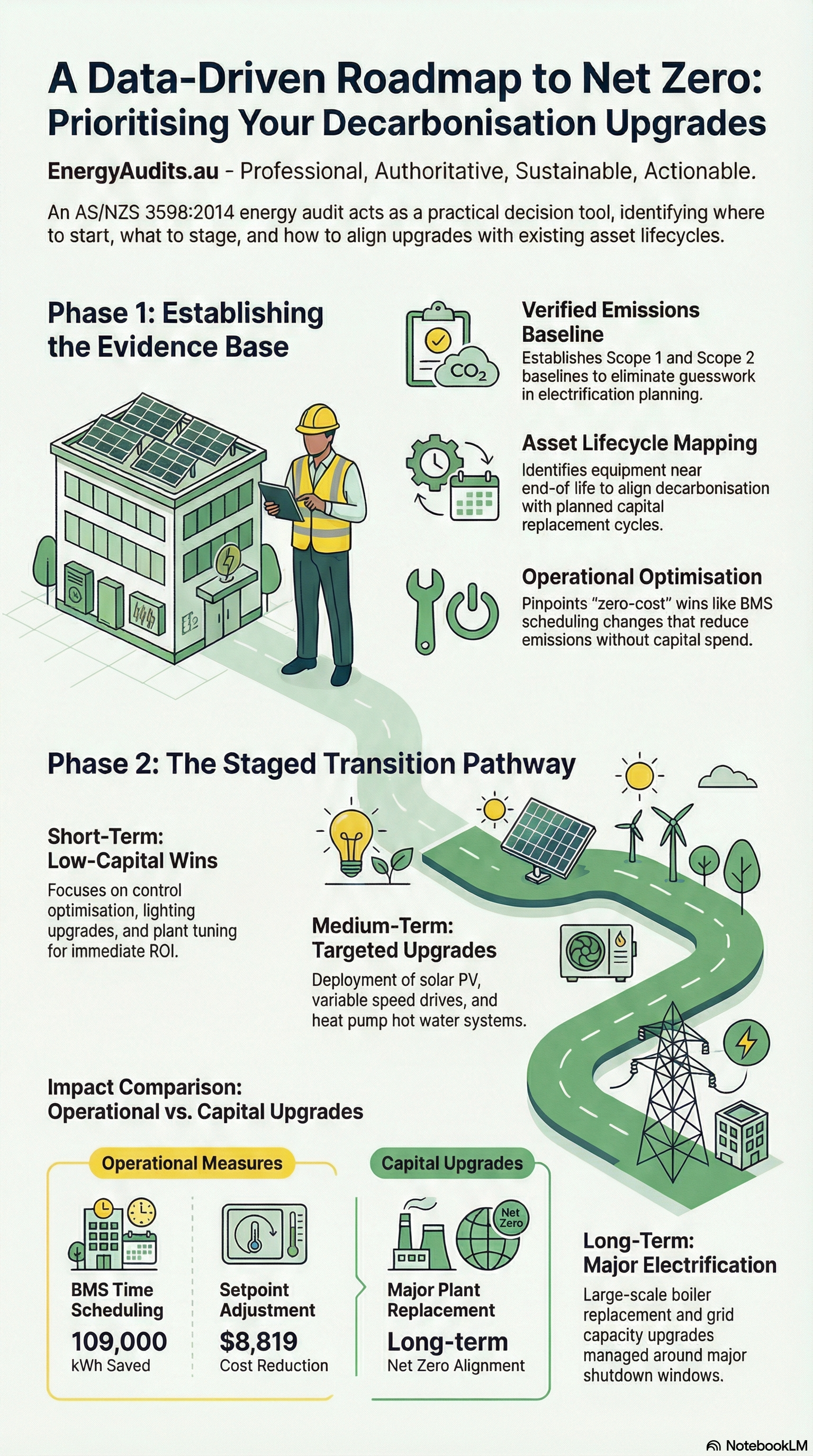
An energy audit establishes:
Your Scope 1 and Scope 2 baseline
Where energy is actually consumed
Which systems drive peak demand
Which assets are near the end of life
Where control changes can reduce emissions without capital spend
Without this baseline, electrification plans become guesswork.
What an audit reveals on a real site
In practice, we see three common patterns on commercial and industrial sites across Australia.
Large base load outside operating hours
Interval data often shows 24-hour energy use that is not operationally required. HVAC, pumps, or compressors run longer than needed. These are short-term fixes. Timer changes, BMS optimisation, and setpoint adjustments often deliver immediate emission reductions at minimal cost and without requiring a shutdown.
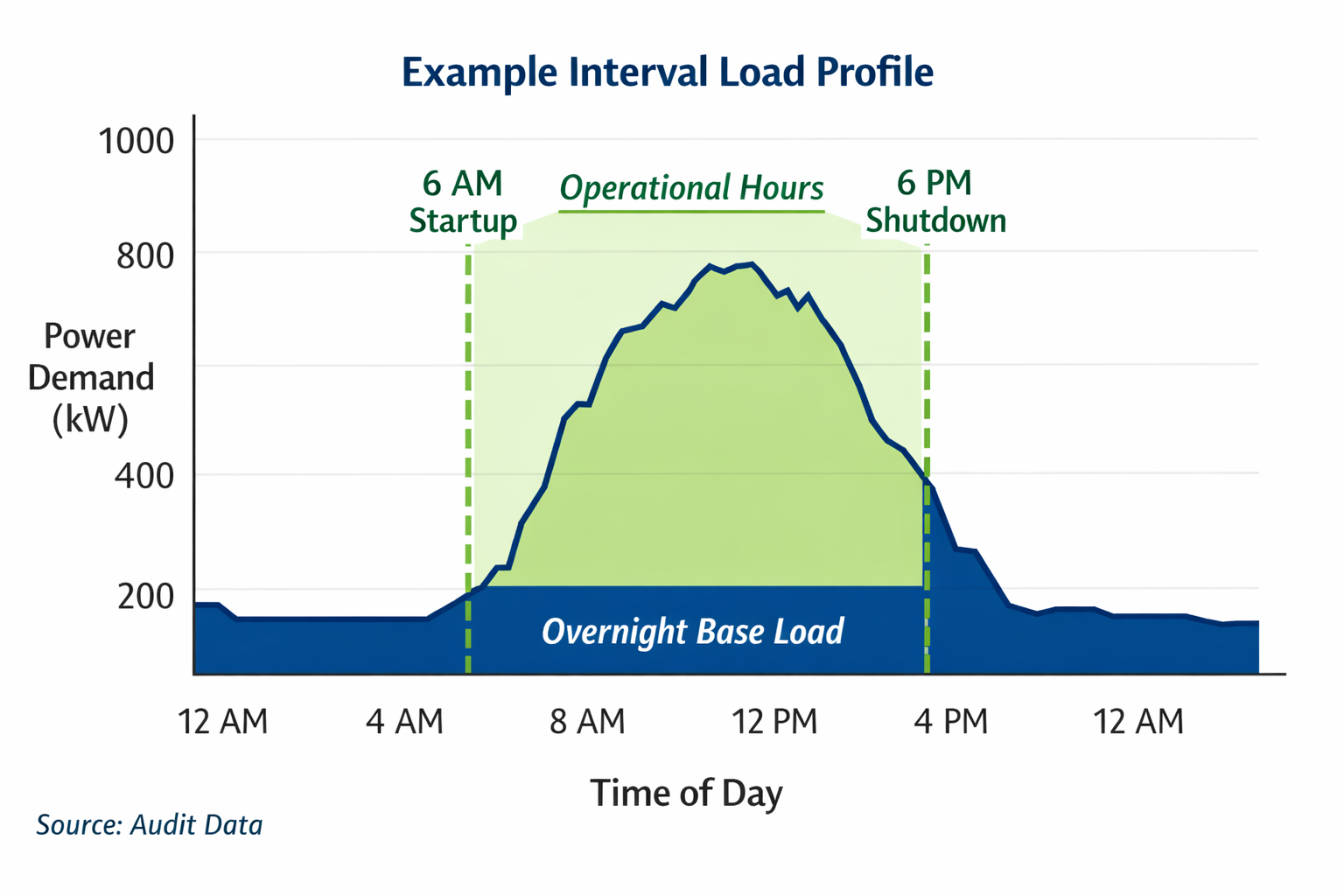
A recent hotel audit demonstrates how this finding typically presents on-site. Interval data from a hotel site identified consistent overnight energy consumption that could not be accounted for by occupancy or operational requirements. On-site investigation during the audit confirmed that the packaged air conditioning units serving common areas and back-of-house spaces had no active time schedule in the BMS. Units were running continuously to a fixed setpoint regardless of occupancy, including through the early morning hours when those areas were unoccupied.
The audit recommendation was straightforward. Time schedules were implemented in the BMS aligned to actual occupancy patterns, with a setback setpoint applied during unoccupied hours rather than a full shutdown, to manage restart loads and protect against temperature extremes in warmer months.
The estimated outcome was a reduction of 109,000 kWh per year, with associated cost savings of $8,819 annually. No capital expenditure was required. The corrective action was completed solely through BMS programming.
Ageing gas plant with limited remaining life
Boilers or direct-fired units are frequently 15 to 25 years old. On many sites, facility managers are already managing reliability issues, sourcing spare parts, or working around intermittent faults. An audit identifies their load profile and replacement timing. This allows electrification through heat pumps or electric systems to be planned in line with asset replacement cycles, rather than being forced early due to a breakdown.
Oversized or inefficient electric plant
Chillers and compressors are often oversized relative to current demand, a legacy of earlier building use or production volumes. Audits quantify part-load performance and identify whether replacement, resizing, or controls optimisation makes more sense before capital is committed.
These findings allow you to build a staged decarbonisation pathway grounded in site reality, not assumptions.
Short, medium, and long-term sequencing
Effective decarbonisation rarely means one large project. It means sequencing upgrades to fit your budget cycles, shutdown windows, and contractor availability
Short term. Operational and low capital actions
Scheduling changes
Control optimisation
Lighting upgrades
Minor plant tuning
These actions quickly reduce energy use and emissions. They also improve data accuracy for larger decisions and do not require extended shutdowns or complex contractor coordination.
Medium term. Targeted system upgrades
Heat pump hot water
Variable speed drives
Compressed air rationalisation
Solar PV expansion
These require moderate capital. An audit provides indicative payback, operational impact, and interaction with existing infrastructure, so decisions are made on evidence rather than vendor estimates alone.
Long term. Major electrification and plant replacement
Boiler replacement with electric systems
Central plant redesign
Switchboard and capacity upgrades
Demand management and tariff restructuring
These projects affect load profiles, maximum demand, and potentially grid connection constraints. For facility managers, they also mean extended planning cycles, complex contractor scopes, and careful staging to avoid operational disruption. An audit assesses available electrical capacity and identifies where upgrade pathways are viable before those commitments are made.
If you are working toward a NABERS improvement, this staged structure directly supports your improvement planning. Our article on How Energy Audits Support NABERS Improvement Plans explains how audit findings translate into a rating uplift strategy.
Balancing efficiency versus electrification
A common mistake is focusing only on fuel switching.
Electrifying an inefficient system does not automatically improve performance. In some cases, reducing demand first produces a better outcome, both financially and operationally.
An audit helps answer:
Should you reduce the load before electrifying?
Does your site have spare electrical capacity?
Will electrification increase peak demand charges?
What is the marginal abatement cost of each measure?
For CFOs and asset managers, this links directly to capital allocation. For facility managers, it reduces the risk of locking in a major upgrade that creates new operational problems downstream.
Linking upgrades to capital planning
Most sites cannot justify large capital projects on emissions alone.
Energy audits support:
Payback and NPV comparison
Risk assessment around ageing assets
Identification of bundled upgrade packages
Alignment with planned shutdowns
For example, if a chiller replacement is already budgeted within three years, electrification or efficiency upgrades can be aligned to that timing. This reduces stranded asset risk and avoids duplicating work. It also avoids the scenario in which a facility manager must coordinate two separate contractor scopes within the same plant within a short period.
Our guide on What You Receive From a Commercial Energy Audit outlines the types of financial modelling and upgrade registers that support these decisions.
Turning ambition into a roadmap
Decarbonisation is often framed in terms of a target year. Net zero by 2035. Carbon neutral by 2040.
What matters on site is the pathway.
A well-structured energy audit provides:
A verified emissions baseline
A ranked list of upgrade opportunities
Clear capital versus operational trade-offs
Identification of grid and infrastructure constraints
A staged transition plan aligned to asset life
This moves decarbonisation from concept to engineering and financial planning, with a sequence that aligns with the operational realities of the people responsible for delivering it.
Next step
If you are planning electrification, developing a decarbonisation roadmap, or preparing a board-level capital plan, an energy audit is the logical starting point.
Contact us to discuss your site, constraints, and upgrade priorities, and determine the right audit scope to support your decarbonisation pathway.
Find out about available energy saving grants and subsidies for your organisation on our Grants page.
