Energy Audits for CFOs. What the Numbers Mean
CFOs sit at the top of all costs and capital expenses - with ever more pressure to reduce rising costs. Energy audits matter because they turn site-level detail into numbers you can trust. Not promises. Not generic savings claims. Decision grade inputs.
This article explains what a commercial energy audit provides as a CFO, how to interpret the numbers, and how to use them within budget cycles, capital planning, and governance processes.
Why CFOs get pulled into energy audits
Energy costs are no longer background noise.
For many commercial and industrial sites in Australia:
Energy is a top-five operating cost
Price volatility creates budget risk
An ageing plant increases unplanned capex
Emissions reporting adds board visibility
An energy audit provides a controlled way to address these pressures. It replaces assumptions with evidence from your actual site.
What an energy audit measures in financial terms
An energy audit does not start with savings targets. It starts with measured reality.
At a minimum, a commercial energy audit quantifies:
Annual energy spent on fuel and tariff
Load profiles showing when energy is used
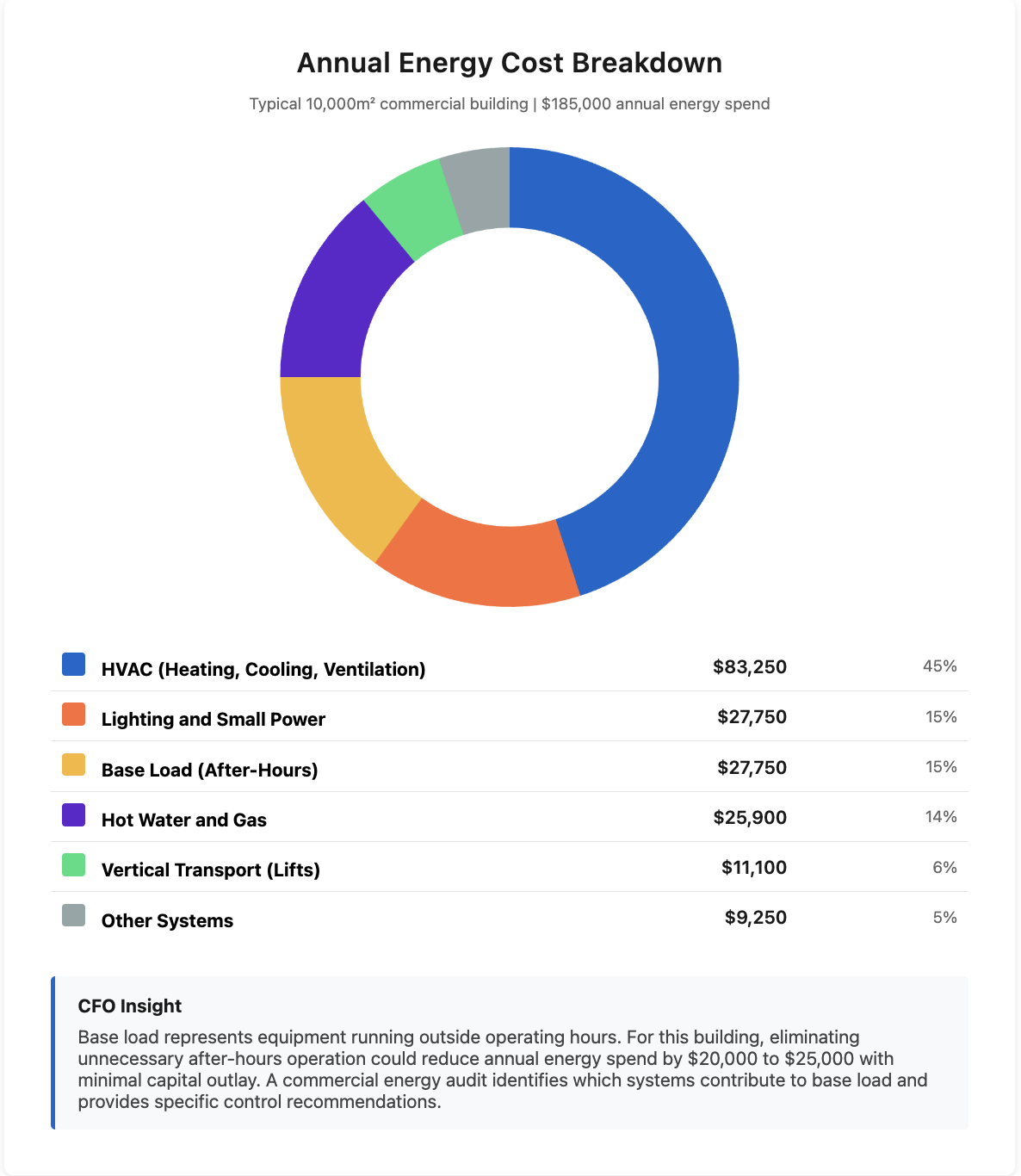
Base load that persists outside operating hours
System-level contributors such as HVAC, refrigeration, process loads, compressed air, and lighting
For a CFO, this matters because it answers one core question.
Where is money actually being spent, and why?
This is different from invoices or high-level energy reports. Audits link cost to physical systems and operating behaviour.
How to read audit savings numbers properly
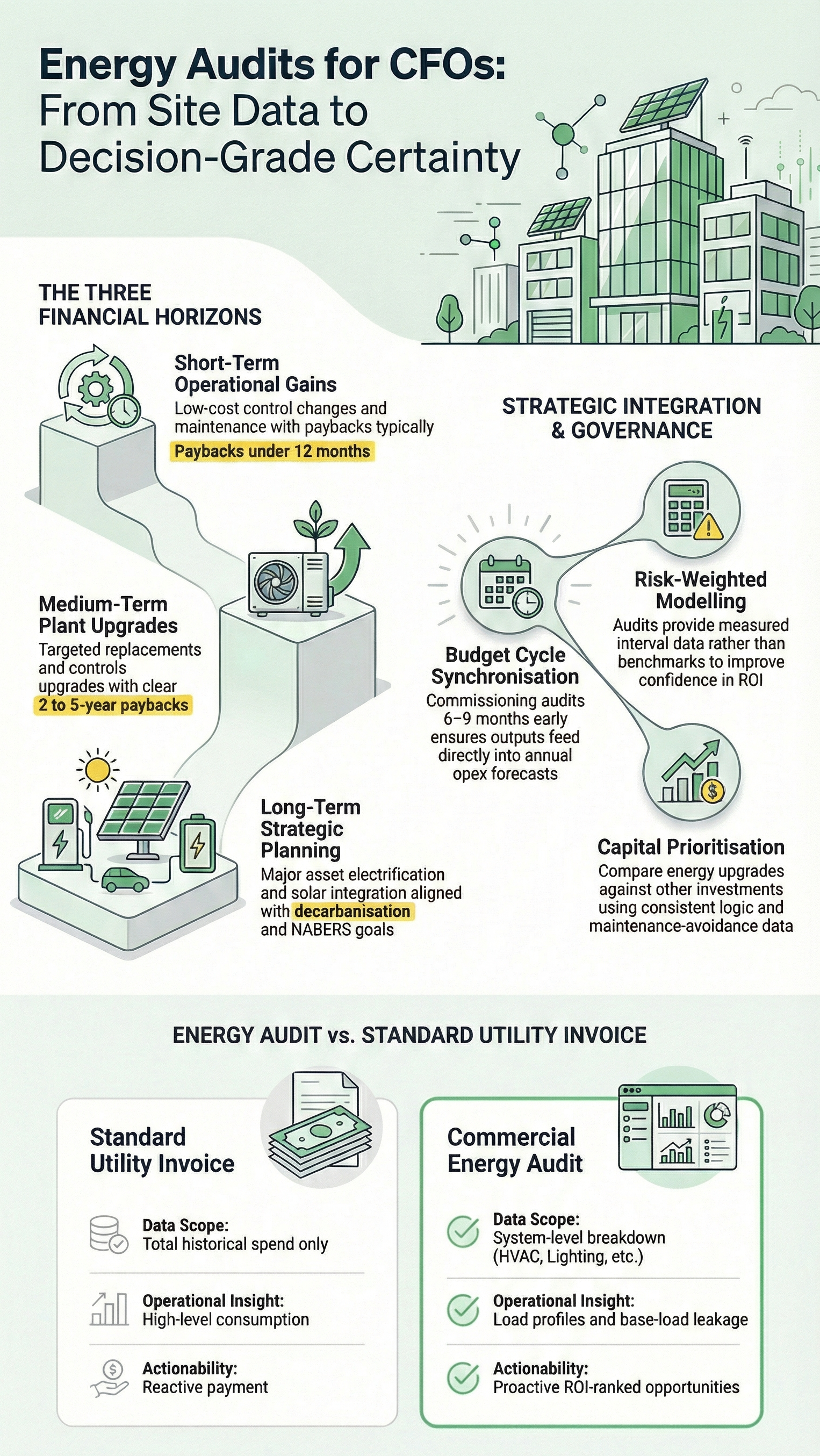
Energy audit reports usually present opportunities across short, medium, and longer horizons.
Short-term actions
These are low or no-capital items.
Scheduling and control changes
Setpoint corrections
Eliminating after-hours operation
Maintenance and recommissioning
Indicative financial characteristics:
Low implementation cost
Paybacks are often under 12 months
High confidence
These are usually the first actions CFOs support because they reduce opex quickly with minimal risk.
Medium-term upgrades
These involve modest capital.
Controls upgrades
Variable speed drives
Targeted plant replacements
Heat recovery
Indicative financial characteristics:
Paybacks in the 2 to 5 year range
Moderate capex
Clear opex reduction
Longer-term capital decisions
These support major asset or decarbonisation planning.
Full plant replacement
Electrification of gas systems
Solar and storage integration
Indicative financial characteristics:
Higher capex
Longer paybacks
Strong linkage to asset life, emissions strategy, and NABERS improvement
A good audit separates these clearly so you can decide what fits your capital cycle
What confidence looks like in an audit
Not all savings numbers carry the same weight.
For CFOs, confidence comes from:
Measured interval data, not benchmarks
Clear assumptions stated in plain language
Site constraints acknowledged
Implementation effort considered
In practical terms, this means an audit should tell you:
What is certain
What depends on behaviour or controls
What relies on future capital approval
This allows you to apply appropriate risk weighting in financial models.
How audits support capex decisions
Energy audits are not business cases. They are inputs to them.
Used properly, audit outputs support:
Capex prioritisation across competing projects
Timing decisions aligned to the asset's end of life
Comparison between energy upgrades and other investments
For example, an audit may show that an HVAC upgrade:
Reduces energy spend by a defined amount
Avoids maintenance escalation on ageing plant
Improves NABERS trajectory
That allows finance to compare it against other capital uses using consistent logic.
This is where energy audits support capital governance rather than bypass it.
Energy audits and budget cycles
One reason audits stall is timing.
From a finance perspective, audits work best when they align with:
Annual budgeting
Mid-cycle reforecasting
Major asset planning windows
An audit completed too late becomes shelfware. One completed ahead of budget season feeds directly into:
Opex forecasts
Capex planning
Board papers
This is why many organisations commission audits 6 to 9 months before major budget decisions.
How audits reduce financial risk
Beyond savings, audits reduce risk in less visible ways.
They help CFOs:
Identify hidden base load cost leakage
Avoid under-scoped plant replacement
Reduce reliance on vendor claims
Improve confidence in emissions reporting
For organisations reporting under NABERS or broader ESG frameworks, audits also support consistency between financial and sustainability narratives.
What CFOs should expect to receive
A commercial energy audit suitable for CFO use should include:
Clear cost baselines
Ranked opportunities with indicative costs and savings
Stated assumptions and exclusions
Implementation considerations
A pathway, not a shopping list
If the report cannot be translated into a spreadsheet or board slide, it is not doing its job.
You can see what a complete audit deliverable looks like in our guide to what you receive from a commercial energy audit.
How does this fit with other roles?
CFOs are not expected to manage energy projects.
Audits work best when:
Facility Managers validate site practicality
Operations Managers confirm operational impact
Finance assesses commercial viability
This shared view reduces friction later. It also prevents projects from being reworked after approval.
If you want to understand how audits support site teams, see our articles on energy audits for Facility Managers and energy audits for Operations Managers.
When an audit is worth doing
From a CFO's perspective, audits usually make sense when:
Annual energy spend is material to opex
Assets are ageing or unreliable
Capital decisions are approaching
Emissions performance is under scrutiny
They are decision tools. Not compliance exercises.
Next step
If you are responsible for budgets, capital approval, or board reporting, an energy audit gives you numbers you can test, challenge, and use.
If you want to understand how audits support site teams, see our articles on energy audits for Facility Managers and energy audits for Operations Managers.
Find out about available energy reduction grants and subsidies for your organisation on our Grants page
