Energy Audit Cost in Australia. What Drives Price
Energy audits sit at the intersection of cost control, risk management, and capital planning. If you are approving budgets or preparing a business case, the first question is simple. How much does an energy audit cost, and what drives the price?
This guide explains the factors that drive energy audit pricing in Australia. It is written for CFOs, Asset Managers, and Facility Managers who need clarity before committing budget.
What an energy audit typically costs in Australia
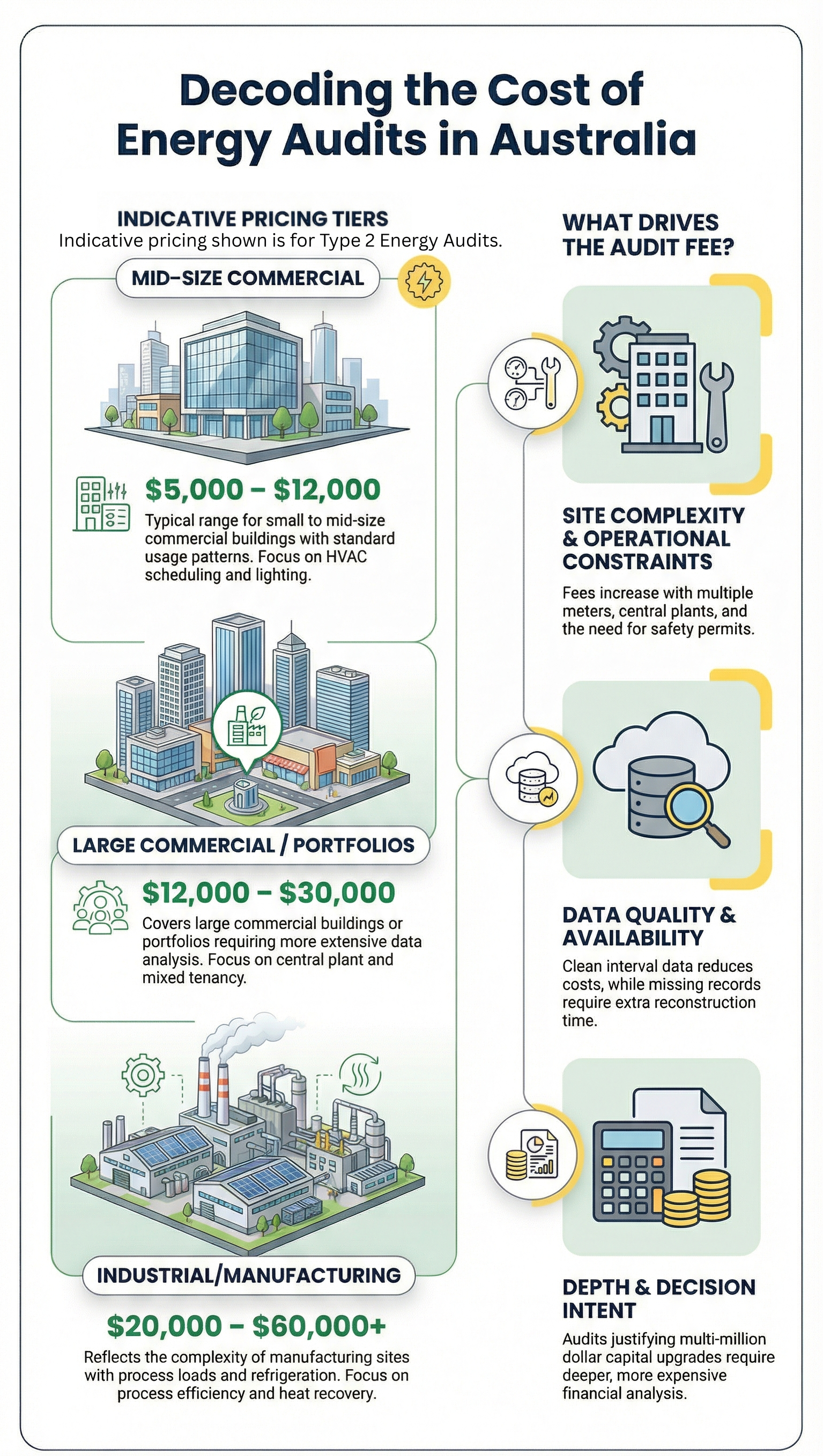
For commercial and industrial sites in Australia, energy audit costs usually fall into these broad ranges.
Small to mid-size commercial buildings. $8,000 to $22,000
Large commercial buildings or portfolios. $18,000 to $35,000
Industrial or complex manufacturing sites. $20,000 to $60,000+
These figures are indicative only. The real cost depends on scope, site conditions, and the decisions the audit needs to support.
If the price looks low, something is usually missing. If it looks high, the scope is often tied to major capital or risk decisions.
Energy audit cost by audit type
Type 1 energy audit.
From $3,500.
Best suited for sites with an indicative monthly energy spend of $2,000 to $6,000.
A Type 1 audit provides a high-level overview of energy use and obvious inefficiencies. It is typically desktop-heavy with limited site time.
Type 2 energy audit.
From $8,000.
Best suited for sites with an indicative monthly energy spend of $6,000 to $20,000.
A Type 2 audit involves detailed site inspections, data analysis, and system-level assessment. This is the most common audit level for commercial buildings.
Type 3 energy audit.
From $24,000.
Best suited for sites with an indicative monthly energy spend of at least $20,000.
A Type 3 audit is designed to support major capital and operational decisions. It includes deeper modelling, stronger assumptions, and higher confidence outputs.
What you are paying for
An energy audit is not a walk-through inspection and a list of ideas. A proper audit is a structured investigation of how energy is used, where it is wasted, and what can realistically be changed.
Your cost covers:
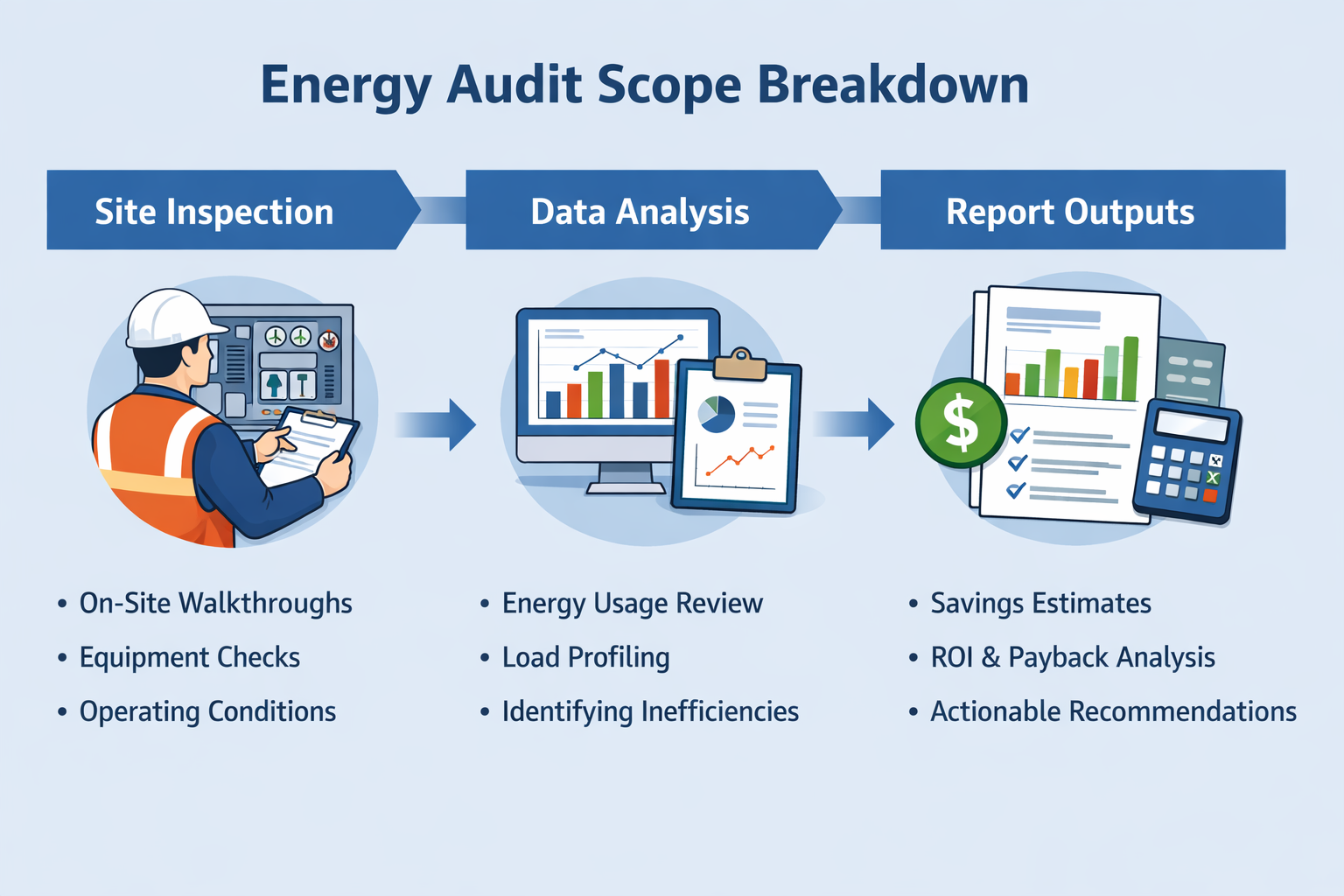
Site inspections and plant walkthroughs
Analysis of electricity and gas data
Load profiling and demand review
System-level assessment of HVAC, lighting, process loads, and controls
Identification and prioritisation of opportunities
A report that supports operational or financial decisions
The more the audit needs to support capital approval or risk reduction, the more time and expertise are required.
For a detailed breakdown of what a commercial energy audit includes, see our guide on Commercial and Industrial Energy Audits Australia.
The main drivers of energy audit cost
Size and complexity of the site
Floor area matters, but complexity matters more.
A 20,000-square-metre office with a central plant, multiple tenants, and after-hours usage can cost more to audit than a larger, simpler warehouse.
Cost increases when sites have:
Multiple buildings or meters
Central chilled water or boiler plant
Process loads or production equipment
Mixed tenancy or extended operating hours
Each system adds time on-site and analysis effort off-site.
Data quality and availability
Good data reduces audit time. Poor data increases it.
If your site has:
12 months of clean interval electricity data
Clear gas billing records
Basic sub metering
The audit is faster and more accurate.
If data is missing, inconsistent, or split across accounts, the auditor needs extra time to reconstruct usage patterns. That time shows up in the fee.
Understanding your site's energy data and patterns before an audit can reduce both cost and timeline.
Audit depth and decision intent
Energy audits in Australia follow AS and NZ standards, but you do not need to memorise them to understand pricing.
At a high level:
High-level audits focus on obvious issues and low-cost actions
Detailed audits analyse system performance and quantify savings
Investment-focused audits support capital decisions and funding
The deeper the analysis, the higher the cost. This is where price differences are often misunderstood.
If you are using the audit to approve a $2 million plant upgrade, a low-cost audit is a risk, not a saving.
Operational constraints on the site
Live sites cost more to audit.
Audits take longer when:
Equipment cannot be shut down
Access is restricted to certain hours
Safety inductions and permits are required
Contractors must be coordinated
Manufacturing sites often fall into this category. The audit scope must work around production, not disrupt it.
That constraint adds planning and site time. For Facility Managers dealing with ageing equipment, tight maintenance windows, and unplanned breakdowns, coordination becomes critical. The audit needs to fit around operational risk, not create more of it.
Reporting and financial analysis requirements
Some audits are used to identify opportunities. Others are used to justify spending.
Costs increase when the report needs to include:
Quantified savings with assumptions
• Simple payback and cash flow impacts
• Capex estimates with confidence ranges
• Staged implementation options
CFOs usually need this level of clarity. Facility Managers often need it to secure approval.
Example scenarios
Example 1. Medium office building
A CBD office building with central HVAC, stable tenancy, and good billing data.
Audit focus:
After-hours energy use
HVAC scheduling and control issues
Lighting upgrades and controls
Typical cost. $8,000 to $22,000.
Outcome. Clear low-disruption savings and a short list of medium-term upgrades.
Example 2. Manufacturing facility
A food processing site with refrigeration, compressed air, and gas process heating. For industry-specific audit considerations, see our Energy Audits for Manufacturing guide.
Audit focus:
Base load and peak demand drivers
Process equipment efficiency
Heat recovery and control strategies
Typical cost. $25,000 to $45,000.
Outcome. Fewer opportunities, but higher value and higher risk decisions.
Why is the cheapest rarely the best
A low-priced audit often means:
Limited site time
Generic assumptions
No meaningful financial analysis
This creates problems later. The business either delays action or commissions another audit to answer the questions that matter.
From a financial perspective, the audit should reduce uncertainty. If it does not, the cost saving is false.
If you are managing a tight budget with pressure to show results, a low-quality audit creates more work, not less. It forces you to re-justify the spend or operate with incomplete information when equipment fails.
How to approach budget approval
If you are approving or preparing a budget, focus on alignment.
Ask these questions:
What decisions will this audit support
What risks does it need to reduce
What level of confidence is required
When scope and intent are clear, the price usually makes sense.
Linking cost to value
An energy audit is a decision support tool. Its value lies in avoiding mistakes, prioritising spend, and clearer sequencing of actions.
Most organisations do not need the most detailed audit available. They do need one that matches their site, constraints, and approval pathway.
Next step
If you are trying to validate budget, scope, or audit depth, the best approach is a brief discussion of your site and constraints.
You can request an energy audit for an initial discussion to confirm what level of audit makes sense before committing to spending.
Find out about available energy saving grants and subsidies for your organisation on our Grants page.
